





A Star's 70-Year Nap
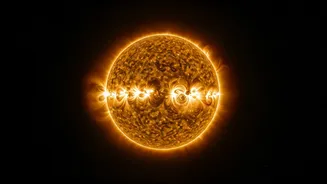
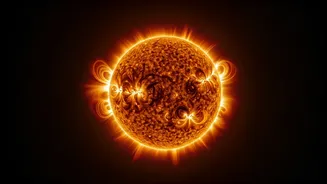
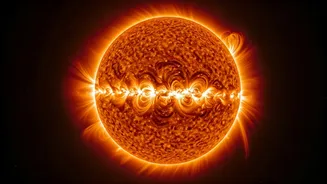
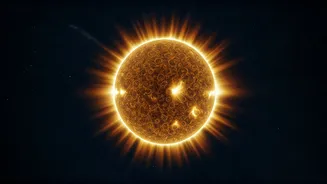
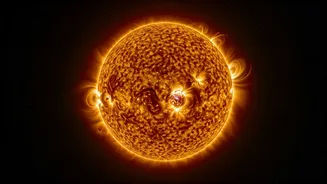
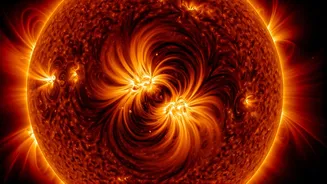
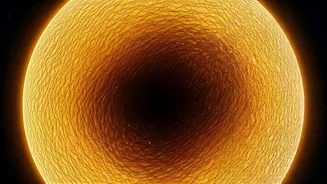
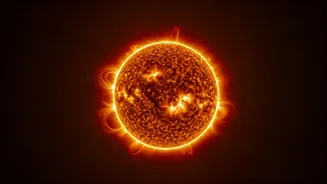
Between roughly 1645 and 1715, the Sun took an unprecedented break. This period, known as the Maunder Minimum, saw an almost complete disappearance of sunspots, which are the most visible sign of the Sun's magnetic activity. For decades, astronomers who
pointed their newfangled telescopes at our star saw a mostly blank, featureless face. This wasn't just an academic curiosity; the Maunder Minimum coincided with the peak of the 'Little Ice Age,' a period of distinctly cooler temperatures, especially in the Northern Hemisphere. For a long time, scientists have puzzled over what could cause our star's internal engine to slow down so dramatically and have searched for clues that could help predict the next big sleep.
The Search for a Warning Sign
Common sense suggests that a massive system like the Sun wouldn't just turn off its activity overnight. The prevailing theory was that there must have been some kind of warning sign or a gradual decline in the decades leading up to the Maunder Minimum. Scientists assumed that the Sun’s regular 11-year cycle of activity and rest must have sputtered, weakened, or showed some other irregularity before it ground to a halt. The hunt was on for this 'precursor' signal, a breadcrumb trail in the historical data that would point to the coming quiet. Finding such a signal would not only solve a historical mystery but also provide a crucial tool for predicting any future 'grand solar minima' and their potential effects on Earth.
Cosmic Detective Work
Since we can't travel back in time, scientists have become cosmic detectives, using clever proxies to read the Sun's ancient history. The main clues are special atoms called cosmogenic radionuclides, such as Beryllium-10 and Carbon-14. These are created in Earth’s upper atmosphere when it's bombarded by high-energy cosmic rays from deep space. The Sun's magnetic field acts as a shield against these rays. When the Sun is active, its shield is strong, and fewer cosmic rays get through, meaning less Beryllium-10 and Carbon-14 are made. When the Sun is quiet, its shield is weak, and production of these isotopes goes up. By measuring the amounts of Beryllium-10 trapped in ancient ice cores and Carbon-14 preserved in tree rings, scientists can create a year-by-year record of solar activity stretching back thousands of years.
An Unexpectedly Normal Past
When scientists applied modern analysis to these detailed proxy records, they found something shocking. In the years just before the Maunder Minimum began, there was no long, slow decline. The Sun's activity, as recorded by the isotopes, was behaving perfectly normally. The standard 11-year cycle appeared to be ticking along just as it had for centuries. Then, it simply fell off a cliff. Instead of a gradual winding down, it seems the Sun's internal engine—its 'dynamo'—can abruptly switch states. It was a perfectly healthy, active star one cycle, and then it entered a state of profound inactivity the next. This finding completely upends the old assumptions and paints a new picture of a star that is far more unpredictable than we imagined.
Why This Changes Everything
The discovery that the Sun can enter a grand minimum without any obvious warning has significant implications. It makes the task of predicting future solar quiet periods incredibly difficult. Such predictions are vital for our modern, technology-dependent society. Solar activity drives space weather, which can disrupt satellites, damage power grids, and affect communications. While some have speculated that a new grand minimum could help counteract global warming, scientists estimate the cooling effect would be minor and nowhere near enough to offset the impact of human emissions. The real takeaway is that the star we depend on for everything has a switch, not just a dial, and we currently have no way of knowing when it might get flipped next.