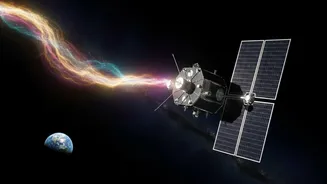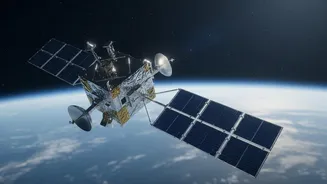

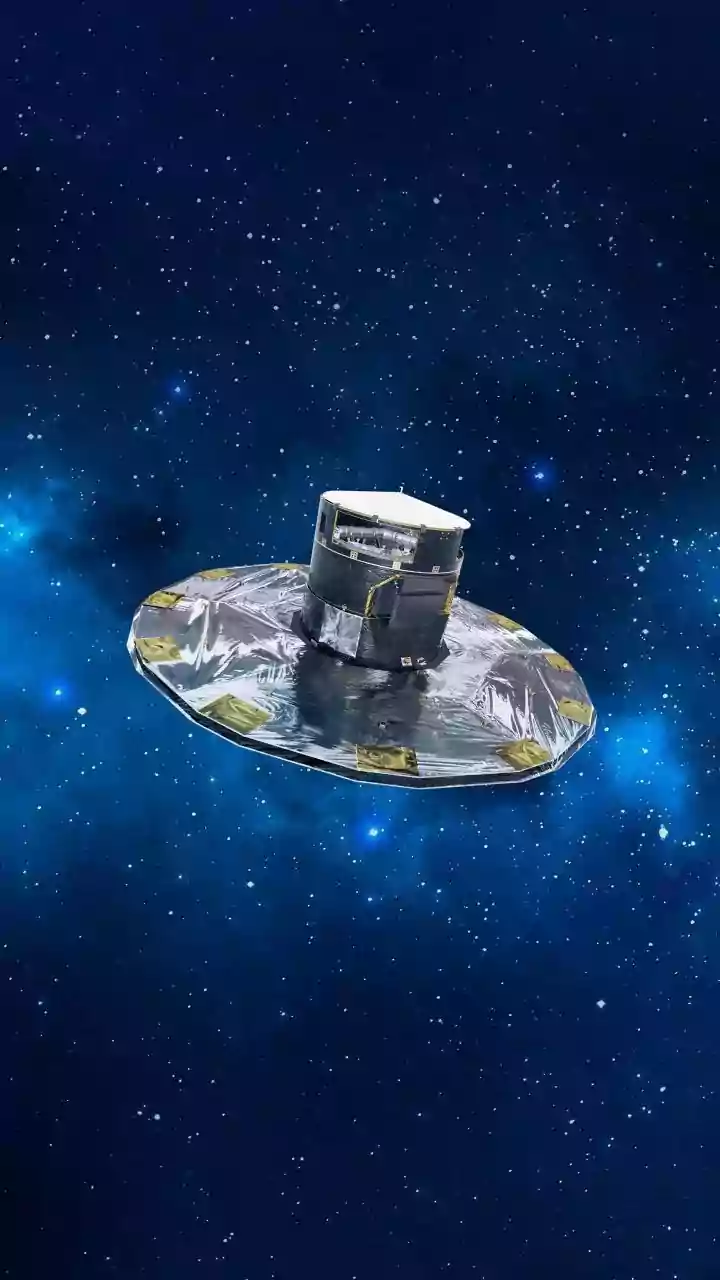


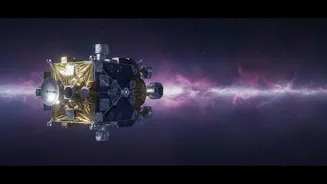
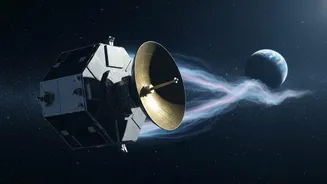
NASA's IMAP probe has released its first public data, offering new insights into the protective bubble at the edge of our solar system. Here's what it means.
Meet Your Cosmic Shield: The Heliosphere
Imagine the Sun constantly blowing a stream of charged particles, called the solar wind, in all directions.
This isn't just a gentle breeze; it's a powerful outflow that travels past all the planets, pushing back against the material floating in interstellar space. This process inflates a vast, protective bubble around our entire solar system known as the heliosphere. This bubble isn't a perfect sphere but is thought to be shaped more like a comet, with a rounded nose and a long, trailing tail. The heliosphere is our first line of defence against galactic cosmic rays—highly energetic particles from distant cosmic events. Without this shield, Earth would be bombarded by much more intense radiation, which could have dramatically altered the course of life on our planet.
What is the IMAP Mission?
The Interstellar Mapping and Acceleration Probe, or IMAP, is NASA's state-of-the-art celestial cartographer. Launched in September 2025, the spacecraft traveled for months to its destination: a gravitationally stable spot about 1.5 million kilometres from Earth, toward the Sun. From this vantage point, its ten sophisticated instruments can 'listen' to and 'see' the particles streaming in from the solar system's edge and beyond. The mission has two primary goals: to map the boundaries of our heliosphere and to understand how particles get accelerated to such high energies within it and throughout space. Essentially, IMAP is designed to decode the messages carried by these particles to give us a complete picture of our immediate cosmic neighborhood.
What the First Public Data Reveals
After beginning its main science mission in February 2026, IMAP has now made its first batch of data available to the public. This initial release includes measurements collected through April 2026 from seven of the probe's ten instruments. The data provides raw information on the interplanetary magnetic field, the composition of the solar wind, and the characteristics of high-energy ions. While not yet a complete picture, these early results are the building blocks for creating the first-ever comprehensive 3D map of the heliosphere's boundary. One instrument, for instance, has already made significant progress on an all-sky map of neutral atoms arriving from the heliosheath, the turbulent outer region of our cosmic bubble. Another successfully captured the full force of an intense solar flare, proving its resilience and value.
From Mapping Boundaries to Predicting Weather
The data from IMAP is about more than just satisfying scientific curiosity. A deeper understanding of the heliosphere's structure and how it interacts with galactic radiation is vital for human space exploration. As astronauts prepare for missions to the Moon and Mars, they will be traveling beyond the added protection of Earth's magnetic field, relying more heavily on the heliosphere's shielding effect. Knowing how this shield breathes—expanding and contracting with the Sun's 11-year cycle—is crucial for astronaut safety. Furthermore, five of IMAP's instruments are feeding information into a near-real-time data stream called I-ALiRT (IMAP Active Link for Real-Time). This system provides critical, up-to-the-minute information to space weather forecasters on Earth, helping protect our satellites, power grids, and communications infrastructure from disruptive solar events.