



An Ever-Growing Junkyard Above
For over six decades, humanity has been launching objects into orbit. From the first Sputnik satellite to today's sprawling mega-constellations, we've filled the void with technology. But everything has a lifespan. Dead satellites, discarded rocket stages,
and fragments from accidental collisions or deliberate anti-satellite tests now circle the Earth as orbital debris. While the headline figure of over 13,000 tonnes is startling, it only accounts for objects large enough to be actively tracked by global surveillance networks, which are typically bigger than 10 centimetres. According to estimates from the European Space Agency (ESA), the total mass of all human-made objects in orbit is even higher, potentially exceeding 17,000 tonnes as of mid-2026. The vast majority of debris consists of millions of smaller, untracked pieces—from screws and paint flecks to centimetre-sized fragments—each one a potential threat.
Why A Tiny Fleck Is A Big Problem
In space, speed is everything. Objects in low-Earth orbit (LEO) travel at roughly 28,000 kilometres per hour. At that velocity, the kinetic energy of a small object is immense. A paint chip can blast a crater into a space station window, an event that has been observed on the International Space Station. A fragment just one centimetre in diameter carries enough energy to disable a functioning satellite. This isn't a hypothetical risk; it's the operational reality for a global satellite industry that underpins vital services. GPS navigation, financial transactions, weather forecasting, global communications, and critical scientific research all rely on assets that are flying through an increasingly hazardous environment. A single catastrophic impact on a key satellite could have cascading effects on services we use every day.
The Kessler Syndrome Nightmare
The worst-case scenario, famously theorised by NASA scientist Donald Kessler in 1978, is a runaway chain reaction of collisions. It begins when a piece of debris hits a satellite, creating a fresh cloud of thousands of new fragments. Each of those fragments then increases the probability of striking other satellites, generating even more debris. This cascading effect could, over time, render certain orbital altitudes so polluted with junk that they become unusable for generations. Major fragmentation events have already pushed us closer to this reality. The deliberate destruction of the Fengyun-1C satellite in 2007 and the accidental 2009 collision between an Iridium communications satellite and a defunct Russian Kosmos satellite are two of the largest single sources of tracked debris in orbit today.
The High-Tech Cleanup Crew
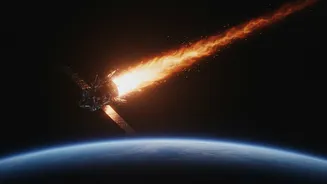
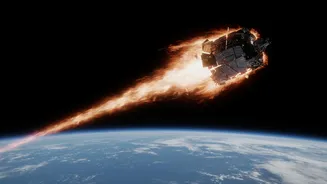
The good news is that the problem is not being ignored. Space agencies and a growing number of private companies are developing innovative active debris removal (ADR) technologies. Imagine space-faring tow trucks, but far more complex. Missions are being designed to capture defunct satellites using everything from robotic arms and giant nets to harpoons. Once captured, the debris can be dragged into a lower orbit where it will burn up harmlessly in the atmosphere. Other futuristic concepts include using ground-based or space-based lasers to gently nudge debris, altering its trajectory enough to cause it to deorbit over time. Companies like Portal Space Systems and ClearSpace are at the forefront, aiming to turn these experimental concepts into a routine service for clearing orbital highways.