
What is a Greatest Evening Elongation?
In astronomy, 'greatest evening elongation' is a technical term for a simple, beautiful event. Because Venus orbits the Sun inside of Earth’s own orbit, it never strays very far from the Sun in our sky. We only ever see it for a few hours after sunset
or before sunrise. The greatest elongation on August 15, 2026, marks the moment when Venus appears at its widest possible angle from the Sun from our earthly viewpoint. This means the planet will be higher in the twilight sky and will remain visible for longer after the Sun has disappeared, offering the best viewing window of its evening appearance. Think of it as Venus stepping out from behind the Sun's glare and taking centre stage in the evening twilight.
The Dazzling Evening Star
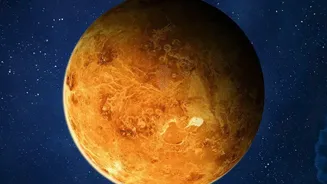
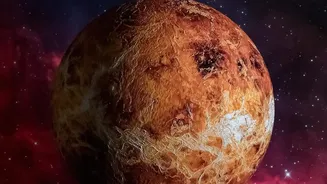
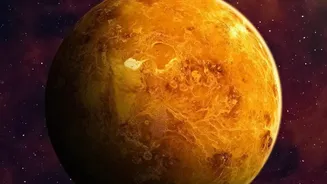
Venus is often called the ‘Evening Star’ or ‘Morning Star’ because of its brilliant, star-like appearance. However, it is a planet, and its light is far more intense and steady than any actual star. This is because its thick, highly reflective cloud cover bounces a huge amount of sunlight back towards us. Around its greatest elongation, Venus will shine at a dazzling magnitude of -4.4, making it the brightest object in the night sky after the Moon. Its brightness is so pronounced that it is often visible even before the sky is fully dark and is sometimes mistaken for an aircraft landing light or even a UFO. On the evenings of August 14 and 15, a very thin crescent Moon will be visible nearby, creating a stunning celestial pairing in the western sky.
When and Where to Look from India
Finding Venus is incredibly easy. On and around August 15, simply look towards the western horizon as the sun begins to set. As the colours of twilight deepen, Venus will emerge as a brilliant, unmistakable point of light. You won't be able to miss it. For observers in India, the planet will be well-positioned for viewing across the country. It will become visible shortly after sunset and will set a few hours later, giving you a generous window to enjoy the sight. While the technical peak of the elongation is on August 15, the views will be almost identical for several days before and after, so don’t worry if you have a cloudy evening on the exact date.
Tips for the Best Viewing Experience
The best part about observing Venus is that you don’t need any special equipment. Its brilliance is easily appreciated with the naked eye. Just find a spot with a relatively clear view of the western horizon, away from the direct glare of streetlights if possible. If you have a pair of binoculars, you're in for a treat. Even standard binoculars are powerful enough to reveal that Venus has phases, just like our Moon. Around its greatest elongation, Venus will appear as a tiny, perfect half-moon. This is a fascinating sight, as it provides direct visual proof that Venus orbits the Sun, not the Earth. To get the steadiest view with binoculars, try bracing your elbows on a solid surface like a wall or a car roof.
A Spectacle That Continues
While August 15 marks the official peak, Venus's reign as the queen of the evening sky is not a one-night-only event. The planet has been a prominent fixture in the west for weeks and will continue to be easily visible throughout August and into September. In the weeks following the elongation, Venus will appear to slowly sink back towards the horizon each evening, getting closer to the Sun's glare. As it does so, its phase will become a thinner, more dramatic crescent, though you'll still need binoculars or a telescope to see it. This celestial event provides a wonderful opportunity to step outside, look up, and connect with the grand movements of our solar system from your own backyard.