



The Date Was a Personal Choice
The date of India's independence, August 15, was not chosen by Indian leaders but by the last Viceroy, Lord Mountbatten. He considered it his lucky day, as it marked the second anniversary of Japan's surrender to the Allied forces in World War II on August 15, 1945,
a moment he presided over as the Supreme Allied Commander in South East Asia. He advanced the date of transfer of power from June 1948 to August 1947, believing an early handover was necessary to avoid escalating violence.
Gandhi Was Not at the Delhi Celebrations
Mahatma Gandhi, the architect of India's freedom struggle, was conspicuously absent from the official independence celebrations in New Delhi. Deeply distressed by the violence of the Partition, he spent August 15, 1947, in Calcutta (now Kolkata), fasting and praying for peace between Hindus and Muslims. For him, the day was one of both rejoicing and sorrow, as he felt the freedom was stained with the blood of Partition.
The National Anthem Was Adopted Later
On its first Independence Day, India did not have an official national anthem. While Rabindranath Tagore's 'Jana Gana Mana' was sung at a session of the Constituent Assembly on August 14, 1947, it was only formally adopted as the national anthem on January 24, 1950. On the morning of August 15, 1947, 'Vande Mataram' was sung on All India Radio at the request of Sardar Vallabhbhai Patel. Both songs played a crucial role in the freedom movement, but the formal designation came later.
The Border Was Drawn by a Man Unfamiliar with India
The man tasked with partitioning the subcontinent, British lawyer Sir Cyril Radcliffe, had never been to India before being given the assignment in July 1947. He was given just five weeks to draw the borders for India and Pakistan, using outdated maps and census data. The resulting 'Radcliffe Line' split villages and communities, leading to one of the largest and most violent mass migrations in human history. Radcliffe reportedly refused his salary after witnessing the ensuing chaos and bloodshed.
The Tricolour Was Adopted Just Before Independence
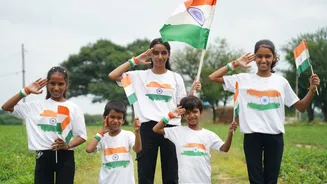
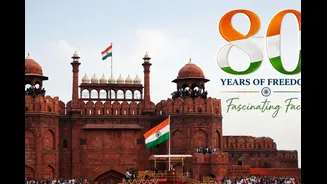
The Indian national flag, in its present form, was adopted by the Constituent Assembly on July 22, 1947, just a few weeks before the country became independent. The design is based on the Swaraj flag of the Indian National Congress. The spinning wheel (charkha) at the centre was replaced by the Ashoka Chakra, the eternal wheel of law, to make it acceptable to all communities.
India Was Not a Unified Nation at First
When the British left, the Indian Independence Act of 1947 gave approximately 565 princely states the choice to join India, join Pakistan, or remain independent. This posed a significant threat to national unity. It was thanks to the tireless diplomatic efforts of Sardar Vallabhbhai Patel, India's first Deputy Prime Minister, and his secretary V.P. Menon, that most of these states were integrated into the Indian Union by August 15, 1947.
Goa Remained a Portuguese Colony
While India gained independence from the British in 1947, some parts of the country were still under European rule. Goa, along with Daman and Diu, remained a Portuguese colony. Despite diplomatic requests from the Indian government, Portugal refused to cede the territories. It wasn't until December 1961, after a military action called Operation Vijay, that Goa was liberated and integrated into India.
The Boundary Line Was Announced After Independence Day
Although the borders dividing India and Pakistan were finalised by Sir Cyril Radcliffe before August 15, the official announcement of the Radcliffe Line was delayed until August 17, 1947. This meant that for two days, millions of people did not know which country their homes would fall into, adding to the confusion and violence of the Partition.
Pakistan's Independence Day Was Shifted
Both India and Pakistan initially observed August 15 as their day of independence. In his first broadcast, Muhammad Ali Jinnah even declared, "August 15 is the birthday of the independent and sovereign state of Pakistan." However, in June 1948, Pakistan's cabinet decided to shift its national celebration to August 14. The reason for the change is attributed to Lord Mountbatten transferring power in Karachi on August 14 so he could be in Delhi for the ceremony on August 15.
India Remained a Dominion for a While
On August 15, 1947, India became an independent nation, but it was a 'dominion' within the British Commonwealth. King George VI remained the formal head of state, and Lord Mountbatten served as the first Governor-General. India transformed into a fully sovereign republic only on January 26, 1950, when the Constitution of India came into effect, and Dr. Rajendra Prasad became the country's first President.