






A World Reimagined
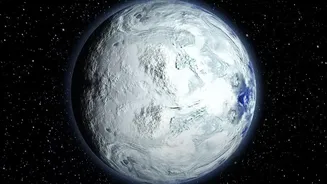
When NASA's New Horizons probe flew past Pluto in 2015, it sent back images that transformed our understanding of the dwarf planet. Instead of a simple, cratered ice ball, we saw towering mountains of water ice, vast plains, and a giant, heart-shaped
glacier made mostly of frozen nitrogen. This feature, called Sputnik Planitia, is larger than Texas and Oklahoma combined and showed signs of surprisingly recent geological activity. The near-total absence of impact craters on its surface indicated that the landscape was being constantly renewed, a process that hinted at a world far more complex than previously imagined. Scientists could see that the nitrogen ice was flowing in slow-motion convection currents, similar to wax in a lava lamp. But the latest findings suggest an even more dynamic process.
Signs of Subsurface Flow
More than a decade after the flyby, a team of scientists led by the Southwest Research Institute (SwRI) took a fresh look at the high-resolution images of Sputnik Planitia. They spotted strange, dark lines and patches along the northern edge of the glacier, concentrated near the boundaries of the large, city-sized convection cells of ice. These features looked familiar. The research team compared them to images from Greenland's ice sheet, where meltwater emerging from below the ice creates similar dark, wetted patterns on the surface snow and ice. While it’s impossible for liquid nitrogen to rain down on Pluto due to its thin atmosphere and extreme cold, the visual parallel was striking. This led them to a startling hypothesis: the marks on Pluto could be evidence of liquid nitrogen seeping up from below and briefly flowing across the surface before freezing again.
The Science of Liquid Nitrogen
So, how could a world with surface temperatures around -230°C possibly host a liquid? The answer lies deep beneath the ice. The Sputnik Planitia glacier is thought to be several kilometers deep. Computer models run by researchers at the SETI Institute show that the immense pressure at the base of this massive ice sheet, combined with modest heat trickling from Pluto’s interior, could be enough to melt the solid nitrogen ice into a liquid state. This liquid nitrogen, being less dense than the solid ice above it, would be buoyant. The models suggest that this liquid could then be forced upward through cracks or conduits in the ice, similar to how magma rises through rock on Earth. Once it reaches the surface, it would have enough time to spread and wet the surrounding area, creating the dark patches seen by New Horizons, before it inevitably refreezes.
A New Kind of Geology
This discovery, published in The Planetary Science Journal, is the first evidence of recently flowing liquid on Pluto. It paints a picture of a geologically active world where subsurface cycles are still shaping the landscape. The process isn't a steady trickle; scientists believe the liquid nitrogen may build up in underground reservoirs and burst out periodically, more like a geyser or volcanic eruption than a gentle spring. This finding elevates Pluto from a static, frozen body to a place with ongoing, dynamic processes. Alan Stern, the principal investigator of the New Horizons mission, noted that "Pluto never stops surprising us." This phenomenon suggests a new kind of time-variable feature that could be unique to such cold, distant worlds. It also raises questions about whether similar processes could be happening on other icy bodies in the Kuiper Belt, like Neptune's moon Triton or the dwarf planet Eris.