





A Moon Unlike Any Other
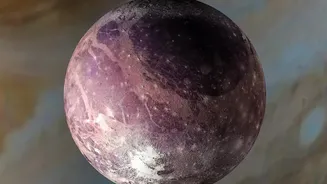
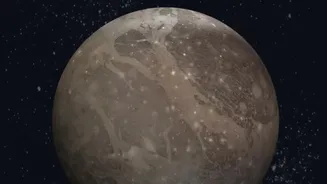
Ganymede is a true giant of the solar system. It is the largest and most massive of all the moons and the only one known to generate its own magnetic field, much like a planet. This unique feature creates beautiful but faint aurorae, or polar lights,
near its north and south poles. Composed of roughly equal parts silicate rock and water ice, its surface is a contrasting landscape of old, dark, cratered regions and younger, lighter, grooved terrains. But its most fascinating feature lies deep beneath this frozen exterior: an ocean thought to contain more water than all of Earth's oceans combined. This tantalizing prospect has made Ganymede a high-priority target for scientists trying to understand where habitable environments might exist.
How a Magnetic Field Unveiled an Ocean
Scientists didn't need to drill through the ice to find this hidden sea. The first hints came from NASA's Galileo spacecraft in the 1990s and early 2000s, which detected Ganymede's intrinsic magnetic field. The real proof, however, came from a clever use of the Hubble Space Telescope. Because Ganymede is embedded within Jupiter’s much more powerful magnetic field, its own magnetic field gets pushed around, causing its aurorae to “rock” back and forth as Jupiter rotates. Scientists calculated that this rocking motion should be about six degrees. But when Hubble observed the aurorae, they only rocked by two degrees. The best explanation for this suppressed movement is a massive, salty, electrically conductive ocean beneath the crust. This ocean generates its own secondary magnetic field that counteracts Jupiter's influence, acting as a massive damper on the auroral rocking.
Sealed Off from the Universe
The discovery confirms that Ganymede's ocean is vast, but it also confirms that it is securely locked away. The moon’s crust is estimated to be around 150 kilometres thick, a formidable barrier of mostly ice. This makes it fundamentally different from other ocean worlds like Saturn's moon Enceladus, which famously erupts plumes of water and ice into space from its subsurface ocean. Those geysers offer a direct sample of the ocean's composition for passing spacecraft. On Ganymede, no such easy access exists. The ocean is completely contained, a self-enclosed system with no direct interaction with the vacuum of space. This means that to understand what is in Ganymede's ocean, we have to go there and find a way to peer through the ice.
Implications for the Search for Life
A sealed ocean presents a mixed bag for astrobiologists. The immense volume of liquid water is a definite plus. However, life as we know it on Earth often relies on the interaction between water and a rocky seafloor, particularly at hydrothermal vents that provide chemical energy and nutrients. For a long time, it was thought that Ganymede's ocean might be sandwiched between two layers of ice, with a high-pressure ice layer at the bottom preventing any contact with the rocky mantle below. More recent models, however, have introduced a more complex “club sandwich” theory. These models suggest that due to salts and immense pressures, Ganymede's interior could be a stack of multiple ice and ocean layers, with the possibility of a final liquid layer resting directly on a rocky seafloor. If this is the case, the crucial water-rock interactions needed to support life might still be possible.
The Future of Ganymede Exploration
Answers to these tantalizing questions may be on the horizon. The European Space Agency's (ESA) Jupiter Icy Moons Explorer (JUICE) mission, launched in April 2023, is on an eight-year journey to the Jupiter system. After arriving in 2031, it will perform numerous flybys of Europa and Callisto before doing something unprecedented: going into orbit around Ganymede itself. This will make it the first spacecraft to ever orbit a moon other than Earth's. Equipped with a suite of powerful instruments, including ice-penetrating radar, JUICE will map the surface, study the magnetic field in exquisite detail, and hopefully confirm the depth and nature of the ocean, potentially even settling the debate about whether it contacts the rocky mantle below.