


Not Fire, Not a Rainbow
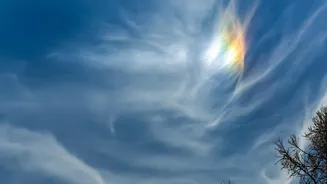
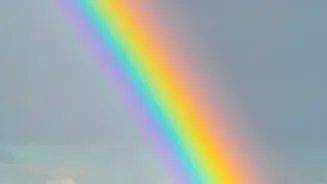
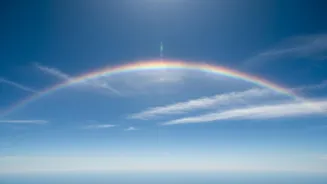
First things first: the phenomenon popularly known as a fire rainbow has nothing to do with fire, and it isn't a rainbow in the traditional sense. The correct scientific name is a circumhorizontal arc. While rainbows are formed by the refraction and reflection
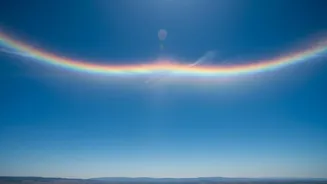
of light in water droplets, a circumhorizontal arc is an optical phenomenon created by the refraction of sunlight through ice crystals in high-altitude clouds. The name "fire rainbow" likely comes from its vibrant, flame-like appearance when seen in wispy, fragmented clouds. Unlike a true rainbow, which forms a curve opposite the sun, this arc is a wide band that runs parallel to the horizon.
The Precise Recipe for a Sky of Colour
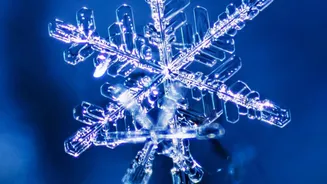
Seeing a circumhorizontal arc is rare because the conditions for its formation are incredibly specific. First, you need high-altitude cirrus clouds, which are thin, wispy clouds that exist at altitudes where the temperature is low enough for them to be composed of millions of tiny ice crystals. These ice crystals must be shaped like flat, hexagonal plates. Second, the sun must be very high in the sky—at an elevation of at least 58 degrees above the horizon. Finally, for the effect to work, the plate-like ice crystals must be suspended horizontally, acting like a vast field of tiny, floating prisms. Sunlight enters through a vertical side face of the crystal and exits through the bottom horizontal face, splitting the light into its component colours.
NASA's High-Definition View
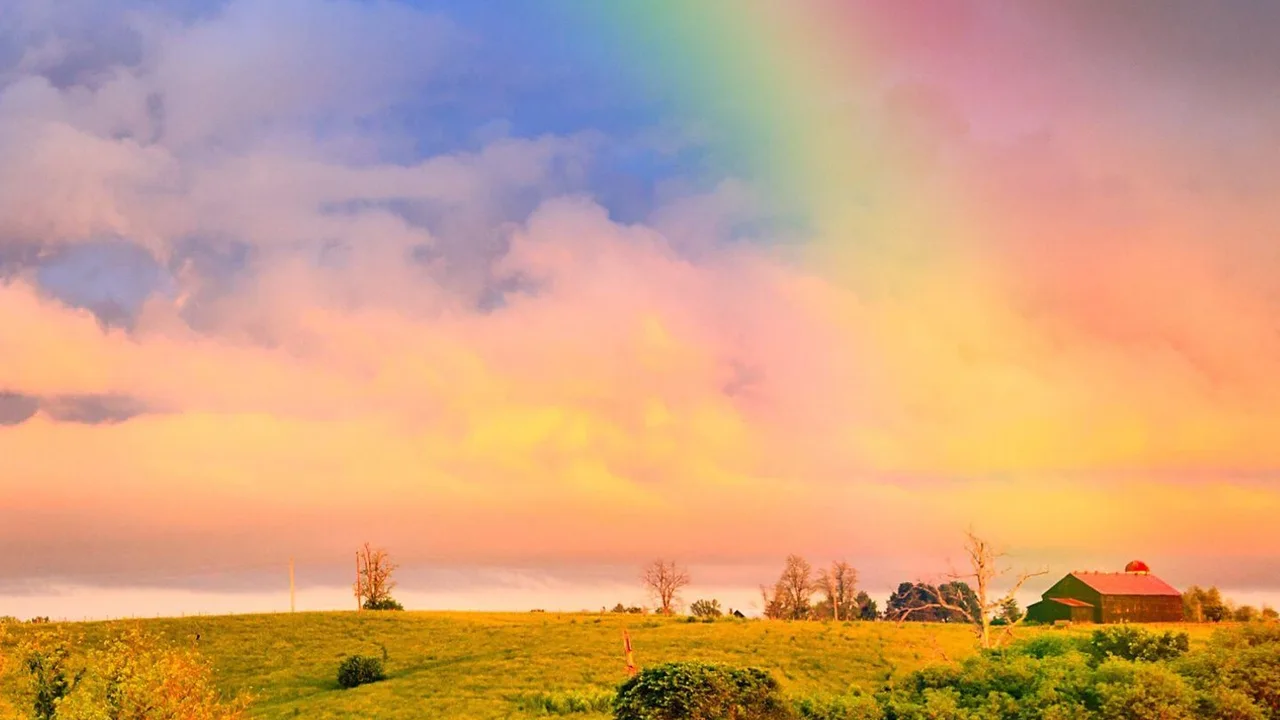
The latest image to capture public attention was featured on August 2, 2026, as NASA's Astronomy Picture of the Day (APOD). While the photograph itself was taken in 2021 over West Virginia, its selection and high-definition presentation by NASA helps scientists and the public appreciate the phenomenon in greater detail. Such images are more than just pretty pictures; they are data. High-resolution photography allows atmospheric scientists to study the structure of the cirrus clouds and the uniformity of the ice crystals within them. The purity and separation of the colours in the arc can tell experts about the quality and alignment of the ice crystals, which is crucial for refining atmospheric models.
What New Details Are Revealed?
While a single image doesn't rewrite the science books, it adds a valuable data point to our understanding of atmospheric optics. The clarity of the featured arc, identified in what appears to be cirrus fibratus clouds, reinforces the specific conditions required for such a vivid display. The more high-quality examples scientists can analyse, the better they can understand the life cycle of cirrus clouds and the formation of various ice halos. By studying the breadth, colour saturation, and completeness of the arc, scientists can infer information about atmospheric waves and turbulence at high altitudes, which can affect weather patterns. Every new, clear observation like this one serves as a real-world test for theoretical models of light refraction and crystal formation, confirming and sometimes challenging existing interpretations. It provides a clearer-than-ever model of what happens when sunlight and ice crystals align perfectly.