





The Universe's Biggest Whodunit
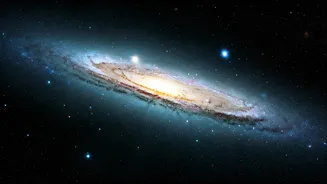
For decades, astronomers have faced a startling reality: the cosmos doesn't add up. Galaxies are spinning so fast they should fly apart, yet something unseen is holding them together with extra gravity. This invisible glue is what scientists call dark
matter, believed to make up about 27% of the universe. It doesn’t emit or reflect light, making it impossible to see directly. Adding to the puzzle is dark energy, an even more baffling phenomenon that constitutes about 68% of the cosmos. This mysterious force is causing the expansion of the universe to accelerate, pushing everything apart at an ever-increasing rate. Together, these two 'dark' components dominate the universe, yet their true nature remains one of the most fundamental questions in science.
Meet Roman: The New Cosmic Detective
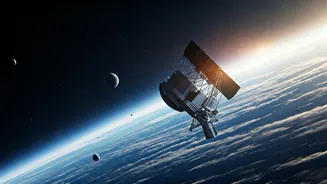
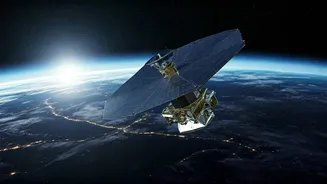
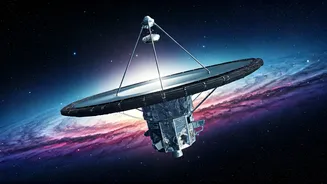
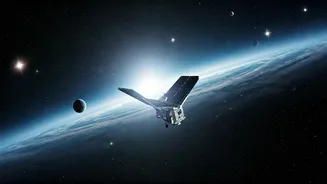
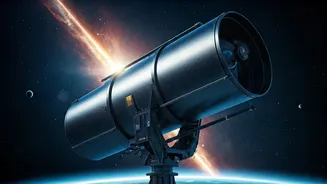
Enter the Nancy Grace Roman Space Telescope, NASA’s next great observatory, scheduled to launch by mid-2027. Named after Nancy Grace Roman, NASA’s first chief of astronomy and the “mother of the Hubble,” this telescope is specifically designed to tackle the puzzles of dark energy and dark matter. While its primary mirror is the same size as Hubble's at 2.4 meters, Roman’s power lies in its extraordinary field of view. Its Wide Field Instrument will be able to capture an area of the sky at least 100 times larger than Hubble can in a single snapshot, while maintaining similar exquisite detail. Think of it as switching from a keyhole to a massive panoramic window overlooking the cosmos.
A Panoramic View of the Cosmos
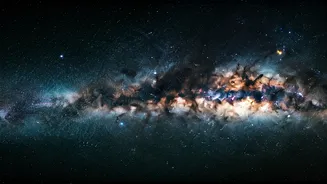
This vast field of view is a game-changer. Roman will be able to map huge swaths of the sky with incredible speed, surveying up to 1,000 times faster than Hubble. In the time it would take Hubble to painstakingly assemble a mosaic of a small patch of sky, Roman can capture it all and more. One of its primary tasks will be to create the largest-ever 3D maps of the universe. By observing millions of galaxies across cosmic time, astronomers can track how the distribution of both visible matter and dark matter has evolved. These maps will reveal how the repulsive force of dark energy and the attractive force of dark matter have shaped the large-scale structure of the universe over billions of years.
Tools of the Trade
To hunt for clues, Roman will employ several clever techniques. It will survey thousands of distant Type Ia supernovae—exploding stars that have a consistent peak brightness. By measuring their apparent brightness and distance, scientists can precisely gauge the expansion rate of the universe at different points in its history, revealing dark energy's influence over time. Another key method is weak gravitational lensing. Massive objects, including clumps of dark matter, warp spacetime, causing the light from more distant galaxies to bend as it passes by. Roman will measure these tiny distortions in the shapes of millions of galaxies to map where dark matter is located and how it's distributed.
More Than Just the Dark Side
While its primary mission is to investigate these dark mysteries, Roman's capabilities will benefit nearly every area of astrophysics. Its wide, deep surveys will also hunt for thousands of new exoplanets, worlds orbiting other stars. It will use a technique called gravitational microlensing, where a foreground star and its planets act as a lens, briefly magnifying the light of a background star. This method is sensitive enough to find planets with masses even smaller than Earth's. Additionally, Roman carries a technology demonstrator called a Coronagraph Instrument, designed to block the overwhelming glare of a star to directly image the faint planets orbiting it—a crucial step toward studying the atmospheres of potentially habitable worlds.