








Every time you use a map on your phone, you are proving Albert Einstein right. The Global Positioning System (GPS) is more than just satellites; it is a daily, large-scale demonstration of his century-old theories of relativity.
Why Perfect Time Is Everything
At its core, GPS works
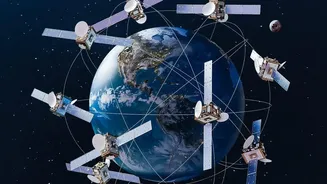
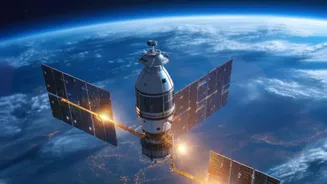
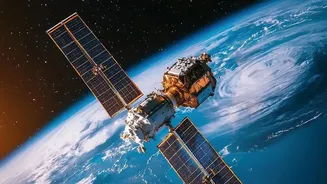
by measuring time. A constellation of satellites, currently numbering 31, orbits roughly 20,200 kilometres above Earth. Each one continuously broadcasts a signal containing its exact location and the precise time it was sent. Your receiver—in your phone or car—listens for these signals from multiple satellites. By calculating the tiny difference between when a signal was sent and when it arrived, it can determine its distance from each satellite. With data from at least four satellites, it triangulates your exact position on the globe. This entire system hinges on breathtakingly accurate timing. The signals travel at the speed of light, so even a minuscule error of one-millionth of a second (a microsecond) could throw your calculated position off by about 300 metres. To prevent this, the satellites use ultra-precise atomic clocks. But a fascinating problem emerges: time itself doesn't pass at the same rate for everyone.
The First Problem: Speed Slows Time
According to Einstein's theory of special relativity, the faster an object moves, the slower its time appears to pass relative to a stationary observer. This effect, known as time dilation, is negligible at everyday speeds but becomes significant for GPS satellites, which zip through space at nearly 14,000 kilometres per hour. From our perspective on the ground, this high velocity makes the atomic clocks on board the satellites appear to tick slightly slower than identical clocks on Earth. The difference is small, amounting to a lag of about 7 microseconds (seven millionths of a second) every single day. If this were the only factor, GPS would still accumulate a positioning error of over two kilometres daily, quickly making it unreliable for navigating city streets.
The Second Problem: Gravity Speeds Time
Einstein's theory of general relativity introduces another twist. It revealed that gravity warps the very fabric of spacetime. The stronger the gravitational pull, the slower time passes. A clock at sea level, deeper in Earth's gravitational well, will tick marginally slower than a clock on a mountaintop. GPS satellites orbit far above the Earth's surface, where gravity is significantly weaker. Because they are in a higher gravitational potential, their clocks tick faster than ours on the ground. This effect, called gravitational time dilation, is much more powerful than the slowing caused by their speed. It causes the satellite clocks to run ahead of Earth-based clocks by about 45 microseconds every day.
A Daily 11-Kilometre Error
So, we have two competing relativistic effects: the satellites' speed makes their clocks lose 7 microseconds a day, while their altitude in a weaker gravitational field makes them gain 45 microseconds a day. The net result is that each satellite's clock runs faster than a clock on Earth by about 38 microseconds daily (45 minus 7). While 38 millionths of a second sounds trivial, in a system that relies on timing to measure distance, it is catastrophic. Light travels about 11.4 kilometres in that amount of time. If left uncorrected, this timing discrepancy would cause GPS position calculations to be off by nearly 11.5 kilometres every single day, rendering the entire system useless within minutes of activation.
The Fix Is Built In
Engineers who designed the GPS system were fully aware of these relativistic effects. In fact, there was some initial debate about whether the effects would be real, but early experiments confirmed they were undeniable. To solve the problem, a brilliantly simple solution was devised. Before a satellite is even launched, its atomic clock is intentionally calibrated to run slightly slower than a clock on Earth. Specifically, the frequency is offset so that once the satellite reaches its orbit and is subjected to the dual forces of special and general relativity, it ticks at the correct rate, perfectly synchronized with ground control. The GPS Control Segment also sends continuous updates to the satellites to correct for any minor drift or variations, such as those from slightly elliptical orbits, ensuring the system remains accurate down to a matter of metres.