


A World Forged by Gravity
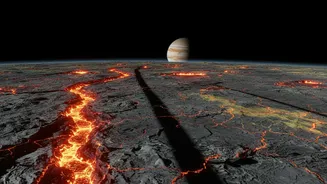
Imagine a world constantly at war with itself, a place where hundreds of volcanoes erupt simultaneously, spewing lava and sulphur across a tortured landscape. This is Io. Smaller than our own Moon, it’s locked in a gravitational tug-of-war with the gas
giant Jupiter and its other large moons. This relentless stretching and squeezing, a process known as tidal heating, generates an incredible amount of internal friction and heat. This energy has to go somewhere, and on Io, it escapes through a staggering number of volcanoes. Ever since NASA's Voyager 1 spacecraft first spotted a volcanic plume in 1979, scientists have been captivated by this hellish wonderland, striving to understand the plumbing system that fuels its unending rage. The central question has always been about the nature of its magma source.
The Great Magma Ocean Debate
For many years, the leading theory was that a vast, global ocean of molten rock sloshed just beneath Io’s crust. This idea, supported by data from the Galileo mission in the 1990s, seemed to explain how volcanoes could be so widespread across the entire surface. A global magma ocean would act as a universal reservoir, able to feed any volcano, anywhere. However, science is a process of constant questioning. Recent, incredibly precise measurements from NASA's Juno probe during close flybys in late 2023 and early 2024 complicated this picture. By tracking how Jupiter’s gravity tugged on Io, scientists determined that the moon’s interior didn't seem to deform in a way that was consistent with a shallow, worldwide magma ocean. This new evidence suggested a different model: that Io’s volcanoes might be fed by more isolated, localized magma chambers, each powering its own eruptive centre.
A New Way of Seeing Heat
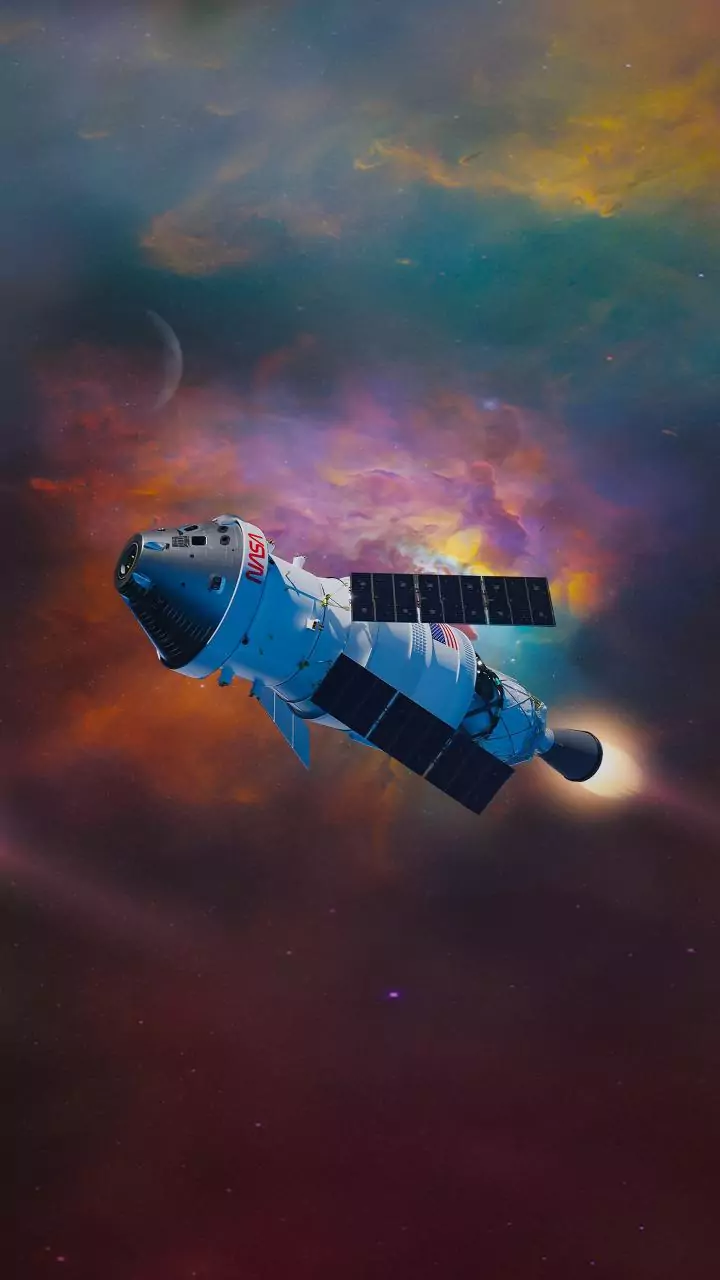
Just as the debate was heating up, the Juno mission has delivered another groundbreaking discovery. Using its Microwave Radiometer (MWR) instrument, scientists have created the first-ever temperature map of Io's subsurface. Previously, our understanding of Io's heat was based on infrared instruments, which can only measure the temperature of the very top of the surface, like taking the temperature of a pizza crust without knowing how hot the cheese is underneath. The MWR, however, operates at frequencies that can penetrate the rock and dust, sensing the thermal glow from as deep as 20 feet below the surface. This is a revolutionary step, giving scientists the ability to peel back a layer and see the heat engine at work.
What the Subsurface Map Reveals
The new map confirms that Io is losing an enormous amount of heat. In every location Juno scanned, the temperature rose steeply just a few feet into the crust, a gradient far too sharp to be explained by solar heating alone. This indicates heat is constantly rising from deep within. The map also pinpoints specific subsurface hotspots. One massive region of underground heat, found near a volcanic complex named Zal Montes Patera, is 10 to 20 degrees Celsius warmer than its surroundings. This directly links a visible surface feature to a powerful heat source just below. Scott Bolton, Juno’s principal investigator, noted this is such a surprising and powerful technique that it could even be used to study volcanoes on Earth, potentially giving us new ways to understand how our own planet’s geology works. The data also revealed another surprise: away from its jagged mountains, Io has vast plains that are remarkably smooth.
Expanding the Science of Alien Worlds
This new subsurface map doesn't end the magma ocean debate, but it adds a crucial new dimension to it. It provides a direct look at the thermal link between the deep interior and the surface volcanoes. It's a new tool in the planetary science toolkit that will help researchers refine their models of how Io works. Understanding tidal heating on Io has implications far beyond Jupiter. This same gravitational process is thought to power the hidden liquid water oceans on other moons like Europa and Enceladus, which are considered prime candidates in the search for extraterrestrial life. By studying this extreme process at Io, we learn the fundamental rules that govern how worlds are heated from within, knowledge that applies to moons across our solar system and to rocky exoplanets orbiting distant stars.