




More Than Just Walking With Poles
Originating in Finland as a summer training method for cross-country skiers, Nordic walking is a specific fitness technique that uses specially designed poles to engage the upper body. Unlike regular walking, which primarily works your legs, this method transforms
a simple stroll into a comprehensive workout. By actively pushing off the ground with the poles, you engage muscles in your arms, shoulders, chest, and back. Research shows that while standard walking activates about 50% of your body's muscles, Nordic walking recruits up to 90%, making it a remarkably efficient exercise.
Higher Intensity, Lower Perceived Effort
The key benefit is a significant boost in exercise intensity. Studies have consistently shown that Nordic walking burns substantially more calories than regular walking at the same pace—with estimates ranging from a 20% to as much as a 67% increase, depending on technique and terrain. Research from the Cooper Institute found an average increase of about 20% in caloric expenditure. Interestingly, many people report that it doesn't feel significantly harder. This is because the poles help propel you forward, which can make the increased effort feel less strenuous while your heart rate and oxygen consumption climb.
A Joint-Friendly Alternative to Running
For those seeking higher intensity without the punishing impact of running, Nordic walking is an ideal solution. Running can generate impact forces of up to three times your body weight with every step, putting significant strain on your knees, hips, and back. Nordic walking, however, is a low-impact activity. The poles help to distribute your weight, reducing the load on your lower body joints. This makes it a sustainable and safer option for people of all fitness levels, including those with joint pain or who are recovering from certain injuries.
Getting the Technique Right
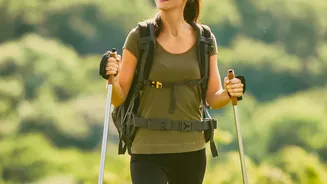
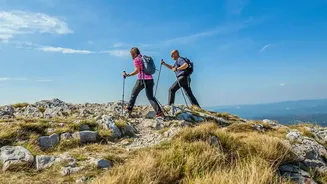
Proper form is crucial to unlock the full benefits. It’s not simply about carrying poles; it's an active process. The basic movement mimics natural walking but with an exaggerated arm swing, keeping the opposite arm and leg forward. The key is to plant the pole behind you at an angle and push off to propel yourself forward. Your posture should be upright with a slight forward lean from the ankles, and your gaze should be directed ahead, not at your feet. The motion should feel rhythmic and fluid. Mastering this technique ensures you engage the upper body and core, rather than just dragging the poles along.
Choosing the Right Gear
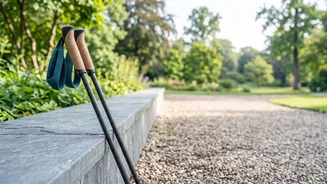
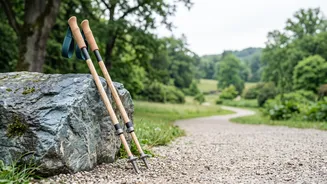
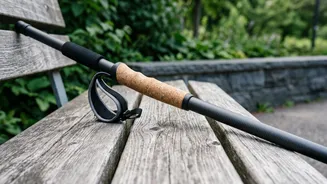
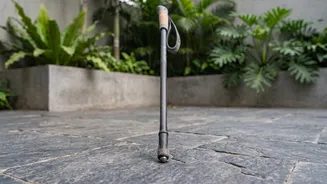
It’s important to use poles specifically designed for Nordic walking, not trekking or hiking poles. While they may look similar, their purpose is different. Trekking poles are designed for stability on uneven terrain and are typically planted in front of the body. Nordic walking poles are built for propulsion and feature a unique glove-like strap system. This strap allows you to push off through the pole without maintaining a tight grip, enabling a proper 'push and release' motion that is central to the technique. The poles often come with angled rubber 'paws' for use on pavement and metal tips for softer surfaces like trails.
Ideal for Your Favourite Routes
As the headline suggests, Nordic walking is perfectly suited for the places you already love to walk. Flat or gently rolling terrain found in parks, on paved paths, and along well-maintained trails is ideal. These surfaces allow you to focus on developing a smooth, consistent rhythm and perfecting your technique without the added challenge of navigating steep or highly technical ground. The predictable surface lets you get the most out of each push, ensuring you maximize the propulsive force from the poles and achieve a full-body workout on every outing.