






The Human-Rated Rocket
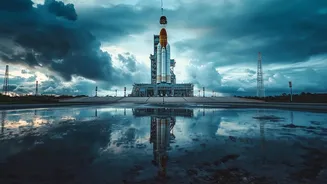
Before Indian astronauts, or 'Gaganyatris', can travel to space, their ride must be proven exceptionally reliable. The first uncrewed mission, known as G1, will be the inaugural flight of the Human-Rated LVM3 (HLVM3) rocket. While based on ISRO's powerful
LVM3 launch vehicle, this version has been significantly modified for crew safety. The G1 mission will serve as the ultimate test flight for the HLVM3, validating its performance and ensuring it can precisely insert the Orbital Module into a low Earth orbit approximately 400 kilometres above the planet. Engineers will monitor every aspect of the rocket's ascent, from the performance of its powerful solid boosters and liquid core stage to the final push from its cryogenic upper stage. A flawless launch is the first, non-negotiable step in the journey.
A Home in Orbit
Once in orbit, the focus shifts to the Orbital Module, which consists of the Crew Module and the Service Module. The Crew Module is the spherical capsule where the astronauts will eventually live. On this uncrewed flight, a special passenger named Vyommitra will be on board. This advanced humanoid robot, developed by ISRO, will simulate human functions and monitor the cabin's environment. The mission will test a version of the Environmental Control and Life Support System (ECLSS), which is responsible for maintaining a breathable atmosphere, and managing pressure, temperature, and humidity inside the capsule. Vyommitra's sensors will provide invaluable data, confirming that the life support systems are ready for future human occupants.
The Fiery Return to Earth
Getting to orbit is only half the challenge; coming home safely is just as critical. The G1 mission will perform a series of complex manoeuvres to test the spacecraft's ability to return to Earth. This begins with de-boosting, where engines fire to slow the spacecraft down and initiate its descent. Shortly after, the Service Module will separate from the Crew Module, a crucial event that must happen cleanly without any issue. The Crew Module will then face the most intense part of its journey: atmospheric re-entry. Protected by a specially designed thermal protection system, or heat shield, the capsule must withstand temperatures reaching thousands of degrees Celsius as it slices through the atmosphere. This phase will validate the module's structural integrity and the effectiveness of its heat shield.
Splashdown and Safe Recovery
The final moments of the mission are a carefully choreographed sequence to ensure a soft and safe landing. After re-entry, the G1 mission will test the full deceleration system. This involves the jettisoning of the apex cover and the deployment of a series of parachutes designed to slow the capsule from hypersonic speeds to a gentle splashdown in the Indian Ocean. But the tests don't end there. Upon hitting the water, the Crew Module Up-righting System (CMUS) will be activated. This system uses gas-inflated bags to ensure the capsule floats in the correct, upright position, a key safety feature for the eventual recovery of the astronauts. The entire recovery sequence, involving teams from the Indian Navy, will also be rehearsed to perfection.