



Meet the Rule-Breaker
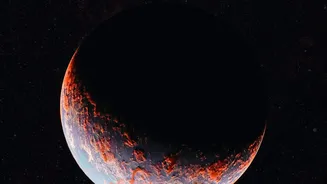
Imagine a planet roughly two and a half times wider than Earth, but packing the mass of nearly 23 Earths into its frame. This is GJ 523b, a celestial heavyweight located about 87 light-years away. Because it packs so much mass into a relatively compact
size, scientists have informally dubbed it a 'mega-Earth'. This category is reserved for an unusual class of ultra-dense, rocky planets. What makes GJ 523b so bizarre is what it's missing: a thick, gassy atmosphere. According to everything we know about how planets form, a world this massive should have used its immense gravity to pull in a huge envelope of hydrogen and helium gas from the disk of material surrounding its young star, eventually becoming a gas giant like Jupiter. Yet, this planet defied expectations, remaining a dense, rocky world with very little gas to speak of.
The Planetary Playbook Ripped Up
Standard planet formation theory provides a clear recipe. As a star is born, a disk of gas and dust swirls around it. Rocky cores form within this disk, and once they reach a critical size—thought to be around 20 times the mass of Earth—their gravitational pull becomes so strong that they begin a rapid phase of gas accumulation. This is how giants like Jupiter and Saturn are believed to have formed. GJ 523b, at 23.5 times Earth's mass, is well past this critical threshold. It had all the right ingredients and the right size to become a gas-swollen giant, but it somehow skipped that step entirely. This discovery forces scientists to reconsider the rulebook. As one researcher noted, dense planets are not uncommon, but they are typically smaller, like Earth or Mercury; one this large is a true anomaly.
So, Where Did The Gas Go?
The most compelling question is what happened to its atmosphere. Scientists are exploring several intriguing possibilities. One theory is a dramatic past involving a planetary collision. It’s possible that two massive protoplanets smashed into each other, merging their heavy rock-and-iron cores while the violent impact blasted away their gaseous outer layers. Another hypothesis is that the planet did form with a thick atmosphere, but it was later stripped away. Given that GJ 523b is part of a relatively young system—only about 170 million years old compared to our 4.5-billion-year-old Solar System—this would have had to happen very quickly and violently, perhaps due to intense radiation from its energetic young star. A third idea is that the planet formed in a 'gas-starved' region of its star's protoplanetary disk, rich in rocky materials but poor in the light gases needed to build a massive atmosphere.
Why This Cosmic Oddity Matters
GJ 523b isn't just a curiosity; it's a crucial test case for our understanding of the universe. Along with other perplexing exoplanets like TOI-1075 b—another incredibly dense super-Earth—it provides a vital data point to refine scientific models. These 'keystone planets' challenge our assumptions and help scientists fine-tune theories of planetary formation. By studying how such a massive world could end up so dense and atmosphere-poor, we can better understand the diverse ways planets can evolve. This knowledge is not just academic. It helps us understand the formation of rocky planets in general, including our own. It also informs the search for life elsewhere; understanding which planets can hold onto their atmospheres is a critical piece of identifying potentially habitable worlds. The James Webb Space Telescope may be used in the future to search for any trace remnants of an atmosphere around these mega-Earths, offering more clues to their mysterious past.