







The Engine at the Centre of the World
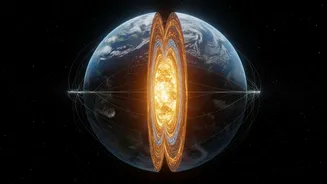
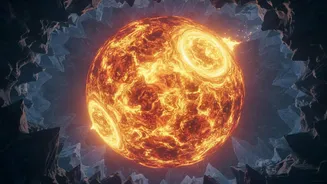
Deep inside our planet, about 2,900 kilometres beneath the surface, lies the outer core. It’s a massive ocean of superheated, swirling liquid iron and nickel. This isn't a static ball of metal; it’s a dynamic, turbulent engine. The constant churning of this
electrically-conductive fluid acts like a giant dynamo, generating the magnetic field that surrounds our planet. For a long time, scientists inferred from subtle changes in this magnetic field that the flow in the outer core was dominated by a steady westward drift.
Earth’s Invisible Shield
This magnetic field, generated by the core, is crucial for life. It extends far into space, forming a protective shield called the magnetosphere. This shield deflects most of the harmful charged particles that stream from the Sun in the solar wind. Without it, solar radiation would strip away our atmosphere, leaving the surface exposed and sterile. The magnetic field isn't perfectly stable; it shifts and weakens in some areas over time, influenced by the unpredictable currents of the liquid core far below. Understanding these changes is vital for everything from animal migration and human navigation to the safety of our technological infrastructure.
An Unexpected Reversal
Recent analysis of nearly three decades of data has revealed a startling event. Around 2010, a huge section of this core flow deep beneath the Pacific Ocean, which had been moving weakly westward, abruptly reversed course and began flowing strongly to the east. This dramatic shift, detailed in a recent study, has challenged the long-held assumption that the core's circulation was relatively stable. The reasons for this reversal are still a mystery, prompting scientists to re-evaluate their models of the deep Earth.
Eyes in the Sky Tell the Story
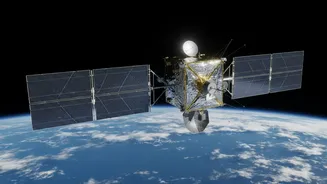
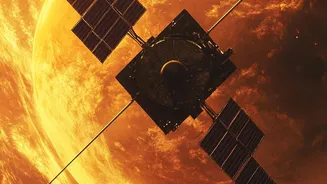
How can we possibly know what’s happening thousands of kilometres underground? The answer lies in space. A constellation of satellites, most notably the European Space Agency's (ESA) Swarm mission, along with predecessors like CHAMP and Ørsted, are equipped with highly sensitive magnetometers. These instruments orbit the Earth, continuously measuring the strength and direction of the magnetic field with incredible precision. By tracking minute fluctuations in the field over time, scientists can create models that infer the motion of the liquid iron in the core. The satellite data, combined with ground-based observations, allowed researchers to pinpoint the 2010 reversal and track its evolution.
What Does This Mean for Us?
While an event happening so deep within the Earth poses no direct danger to people, its implications are significant. The discovery shows that changes in the core can happen much more rapidly—over a single decade—than previously thought. This has practical consequences, as the World Magnetic Model, which is embedded in all navigation systems from smartphones to military aircraft, depends on accurate predictions of the field. The new findings also raise fascinating questions about potential connections between the outer core, the solid inner core, and the rocky mantle above it, suggesting a complex and interconnected dynamic system. Latest data suggests the eastward flow may already be weakening, hinting that this might be part of a longer, mysterious natural cycle.