
A New Solar Super-Telescope
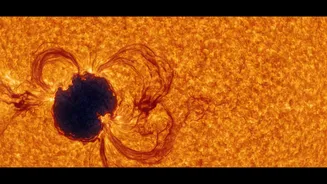
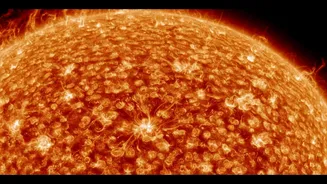
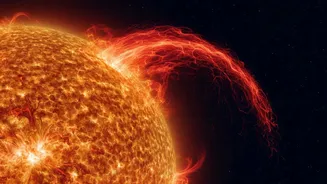
This breathtaking new view comes from the National Science Foundation's Daniel K. Inouye Solar Telescope, located on the island of Maui, Hawaii. It is the most powerful solar telescope in the world, equipped with a massive 13-foot mirror that allows it to
collect more sunlight and see finer details than any instrument before it. The images it has produced are so detailed they can resolve features as small as 12 to 20 kilometres across on a star that is 149 million kilometres away. That’s like being able to spot an object the size of a car from hundreds of kilometres away. This unprecedented clarity is allowing scientists to finally witness phenomena that, until now, only existed in theories and computer models.
Decoding the Fiery 'Swirls'
The entire surface of the sun is a boiling sea of plasma. This energy is transported to the surface through a process called convection, much like the bubbling in a pot of boiling water. Hot plasma rises, cools at the surface, and then sinks back down. This creates massive cells called granules, each one roughly the size of Texas. But the new images reveal something more. Along the dark lanes where the cooler plasma sinks, scientists have observed city-sized vortices, or swirls. For the first time, they have directly witnessed a process called the Kelvin-Helmholtz instability (KHI). This occurs when two streams of fluid or plasma slide past each other at different speeds, creating a shear that whips up into waves and swirls. You’ve seen this instability before in clouds, water, and even in the swirling patterns of Jupiter’s atmosphere, but seeing it on our sun is a major breakthrough.
The Devil in the Details
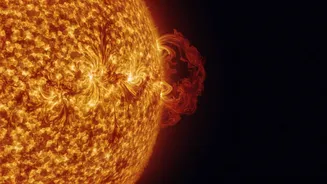
Observing these small-scale swirls is more than just a scientific curiosity; it's a critical piece of a much larger puzzle. Scientists have long been trying to understand how energy is transported and builds up in the sun's atmosphere. These newly confirmed Kelvin-Helmholtz swirls are believed to play a key role in moving energy and magnetic fields around. The constant churning, twisting, and swirling at the edges of these giant convection cells generates tremendous magnetic energy. This energy can build up over time, and when it's released, it can trigger some of the sun's most powerful events: solar flares and coronal mass ejections (CMEs). Essentially, by understanding these tiny, city-sized events, we can get a better handle on the massive explosions that can have effects across the entire solar system.
From Solar Science to Earthly Impact
This research has very practical implications for life on Earth. The solar flares and CMEs that these small-scale processes can lead to are the primary drivers of space weather. When a powerful burst of charged particles from the sun hits Earth, it can cause a geomagnetic storm. These storms can endanger astronauts, disrupt radio communications, damage satellites, and even overwhelm our electrical power grids, potentially causing widespread blackouts. The better we understand the fundamental physics of what causes these eruptions on the sun, the better we can predict them. Advanced warnings allow satellite operators, airlines, and power grid managers to take protective measures, safeguarding the technology we rely on every day. In a way, studying these tiny swirls on the sun is a crucial step in protecting our modern way of life.