







The Blueprint: Robots First
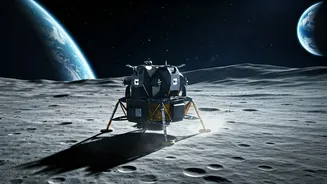
Before astronauts can live and work on the Moon, a tremendous amount of groundwork must be laid. NASA's strategy is to let robots do the dangerous and laborious early work. This initial robotic phase, set to run through 2029, is designed to reduce risk
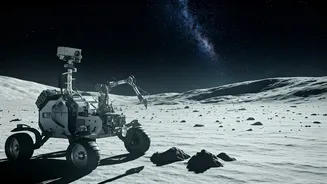
and maximize efficiency. A fleet of rovers, landers, and drones will be deployed to the lunar South Pole. Their primary job is to test critical technologies, map the terrain in detail, prospect for resources like water ice, and begin setting up essential infrastructure. This includes power systems and communication networks, creating a foundation for a sustainable human presence.
Meet the Robotic Construction Crew
This new era isn't about one single machine but a team of specialized robots working together. One key mission is CADRE (Cooperative Autonomous Distributed Robotic Exploration), which will send a trio of suitcase-sized rovers to the Moon. These rovers will autonomously coordinate to explore and create 3D maps of the subsurface, a task impossible for a single robot. Another game-changing technology is being developed by the company ICON under a NASA contract called Project Olympus. The goal is to create large-scale 3D printers that can use lunar regolith—the local dust and rock—as a building material for landing pads, habitats, and roads. This approach, known as in-situ resource utilization, is crucial for long-term settlement, as it dramatically reduces the amount of material that needs to be launched from Earth.
Why This Matters for Future Exploration
Using robots to prepare a lunar base is a fundamental shift in the paradigm of space exploration. The old model was 'there and back again'. The new model, under the Artemis program, is 'there to stay'. By ensuring that landing sites are safe, resources are identified, and basic shelters and power grids are functional before the first crewed landings, NASA is building a permanent foothold on the Moon. This lunar base is not just a destination in itself; it is a crucial proving ground. The technologies and strategies being tested—from autonomous robotics to surviving the brutal, two-week-long lunar night—are essential for the next giant leap: sending humans to Mars.
A Commercial and Global Effort
NASA is not undertaking this monumental task alone. The agency is leveraging partnerships with commercial companies through its Commercial Lunar Payload Services (CLPS) initiative. Companies like Astrobotic, Intuitive Machines, and Firefly Aerospace have been awarded hundreds of millions of dollars in contracts to build the landers that will deliver these robotic systems and scientific payloads to the Moon. This approach fosters innovation, drives down costs, and builds a robust space economy. Recent announcements have confirmed a steady cadence of these commercial missions scheduled through the late 2020s, each one laying another brick in the foundation of the lunar base.