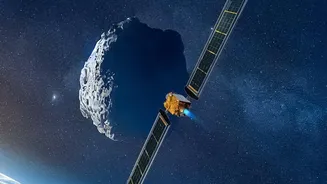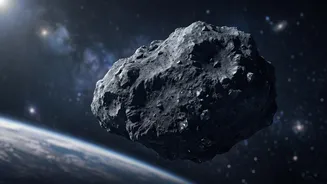








When it comes to protecting Earth from a hazardous asteroid, the plan seems simple: just give it a push. But new research reveals a crucial complication. A groundbreaking model shows that an asteroid's lumpy, irregular shape is a major factor.
The Challenge of Hitting a Moving Target
Humanity's
first real-world test of planetary defense, NASA's Double Asteroid Redirection Test (DART) in 2022, was a remarkable success. The mission sent a spacecraft hurtling into Dimorphos, a small moonlet asteroid, to see if the impact could alter its path. It worked even better than expected, shortening the asteroid's orbit around its larger companion, Didymos, by a full 33 minutes. This success validated the 'kinetic impactor' technique as a viable strategy. But the overwhelming success also created a new puzzle. The push given to Dimorphos was significantly stronger than the spacecraft's impact alone could explain. This pointed to the recoil from the massive cloud of rock and dust blasted into space as a major contributor to the deflection, a factor deeply connected to the asteroid's structure and composition. It confirmed that real-world asteroids are not simple, solid spheres, but are often loose 'rubble piles' that react to impacts in complex ways.
Why Shape Matters So Much
Most asteroids are not the perfect spheres you see in simple diagrams. They are often lumpy, oblong, and asymmetrical, more like a potato or a peanut than a marble. For decades, to make the incredibly complex calculations manageable, many simulations of asteroid deflection have treated them as smooth, uniform balls. This simplification, however, ignores critical physics. Hitting an irregular object off-center can cause it to wobble or tumble unpredictably. Furthermore, the topography of the surface—its mountains, craters, and valleys—dramatically changes how energy from an impact is absorbed and how material is ejected. A blast that hits a flat surface will have a very different effect from one that hits a sloped or concave area. This has been a known challenge, but a new generation of models is finally powerful enough to tackle it head-on.
A New, More Realistic Model
Researchers at Sandia National Laboratories have developed a new simulation that brings unprecedented realism to the problem. Published in the scientific journal Icarus, the model moves beyond spherical assumptions by incorporating high-resolution 3D shapes of actual asteroids like Bennu and Itokawa, mapped by previous spacecraft missions. Led by physicist Nathan Moore, the team developed a new algorithm over 1,600 times faster than previous methods, finally giving computers the power to handle both complex shapes and high-fidelity physics. The model simulates a 'stand-off' nuclear detonation, where a device explodes near an asteroid, bathing one side in powerful X-rays. This vaporizes surface material, creating a powerful thrust that pushes the asteroid. The results were startling. Depending on which side of a lumpy, simulated asteroid was irradiated, the deflection effectiveness varied by nearly five times. Aiming at one side produced a significant nudge, while aiming at another barely moved it at all.
Implications for Planetary Defense
This new understanding doesn't mean our planetary defense strategies are wrong, but it does mean they need to be much smarter. The effectiveness of any deflection attempt, whether from a kinetic impactor like DART or a nuclear pulse, depends heavily on knowing the asteroid's specific shape, rotation, and which face will be pointing toward the impactor at the moment of arrival. 'We expected aim to matter,' said researcher Nathan Moore. 'What surprised us was how much'. The study highlights the critical need for reconnaissance missions ahead of any deflection attempt. Future missions, like the European Space Agency's Hera, which is set to arrive at the DART impact site, will provide more closeup data on the consequences of an impact, further refining these models. Getting a detailed 3D map of a threatening asteroid before sending an interceptor could be the difference between a successful deflection and a failed mission.