




What Does a 'Quieter' Galaxy Mean?
In cosmic terms, 'quiet' doesn't refer to sound but to activity. A galaxy’s vibrancy is measured by its rate of star formation—the chaotic, energetic process of turning vast clouds of gas and dust into brilliant new suns. A 'quiet' galaxy is one where
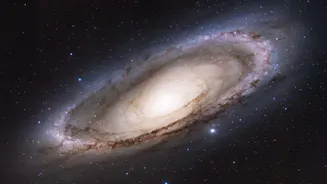
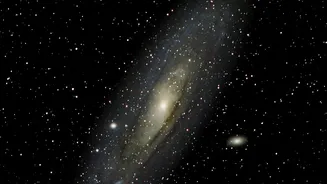
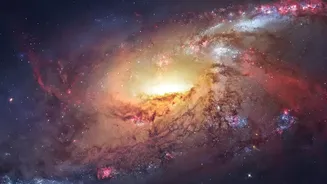
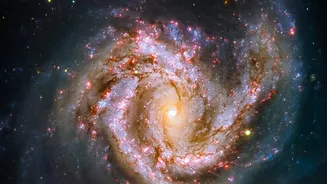
this process, known as star birth, is slowing down. According to a new NASA-supported study, Andromeda's star formation has been steadily declining over the last 500 million years, with the slowdown becoming even more pronounced in the last 40 million years. This indicates the galaxy is transitioning from an active, star-forming powerhouse into a more quiescent, or passive, state.
How Did Astronomers Find This Out?
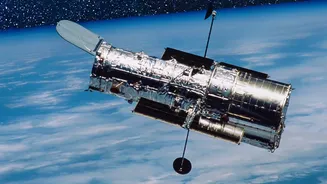
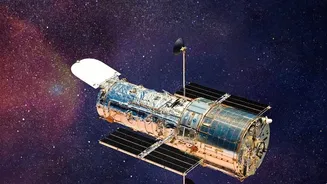
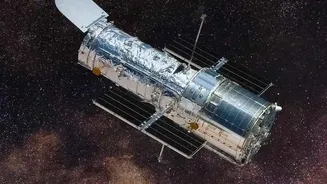
To uncover this galactic secret, astronomers turned to NASA's Hubble Space Telescope, a veritable time machine for looking deep into the cosmos. By analyzing data from two massive Hubble surveys, a team of researchers meticulously measured approximately 200 million individual stars across two-thirds of Andromeda’s vast disk. Young, hot stars burn with a brilliant blue light, while older, cooler stars glow red. By mapping the color and distribution of these stellar populations, scientists created a 'fossil record' of the galaxy's activity. This detailed map allowed them to rewind time and see that regions which were once blazing with star birth are now much calmer.
The Numbers Behind the Decline
The data paints a clear picture of a galaxy winding down. About 500 million years ago, Andromeda was creating stars at a rate of about one solar mass (the mass of our Sun) per year. By 40 million years ago, that rate had already been cut in half. Today, the output has plummeted even further, to about one-fifth of a solar mass per year. Much of this decline is concentrated in a prominent star-forming ring located about 32,000 light-years from the galactic center, which was once a hotbed of activity but has since faded significantly.
Why is Andromeda Slowing Down?
Interestingly, the study suggests Andromeda isn't running out of the raw fuel—gas and dust—needed for star birth. Instead, the galaxy seems to be in a natural cooling-off period following a much more turbulent past. Previous research shows Andromeda experienced a massive burst of star formation about 2 billion years ago, likely triggered by a collision or interaction with another, smaller galaxy. Now, it appears to be settling into a quieter middle age. Scientists also suspect that Andromeda's small satellite galaxy, M32, may have played a role by punching through its disk around 60 million years ago, disrupting stellar nurseries and contributing to the slowdown in nearby regions.
A Glimpse into the Milky Way's Future
Because Andromeda is so similar in size and structure to our own Milky Way, studying its life cycle provides a preview of our own cosmic destiny. Our galaxy is also destined to one day exhaust its primary fuel for star birth and enter a more passive phase. But there’s a dramatic event on the horizon first. Andromeda and the Milky Way are hurtling toward each other at about 110 kilometers per second and are predicted to collide in about 4.5 billion years. While individual stars are unlikely to crash, the gravitational merger will compress remaining gas clouds in both galaxies, likely triggering a final, spectacular burst of star formation before the combined entity, nicknamed 'Milkomeda', settles into its final form as a giant elliptical galaxy.