






Ganymede: A Moon of Superlatives
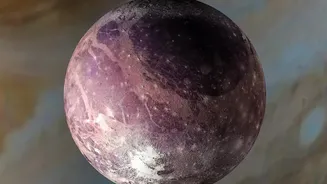
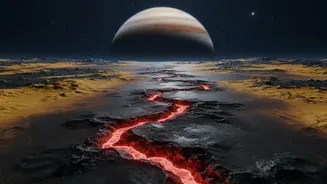
Ganymede is not just any moon; it’s the largest and most massive in our solar system. Discovered by Galileo Galilei in 1610, it’s a world of contrasts, with ancient, dark, cratered regions alongside younger, brighter, grooved terrain. For centuries, it was
just another point of light in the sky. But as our technology grew, so did our understanding of this giant satellite. Scientists had long theorized about its interior based on its size and density, with models suggesting the potential for liquid water. However, proving it would require getting much closer.
The First Clue: A Magnetic Surprise
The first major breakthrough came in the 1990s with NASA's Galileo spacecraft. As it orbited Jupiter, Galileo made a series of close flybys of Ganymede and detected something astonishing: Ganymede had its own magnetic field. This was a monumental discovery, as it was the first and only moon known to generate its own magnetosphere, much like a planet. This intrinsic field suggested that the moon's interior was not a cold, dead block of ice and rock. Instead, it pointed to a dynamic, convecting liquid iron core, similar to the process that generates Earth's magnetic field. But this was just the beginning of the mystery. The data from Galileo’s magnetometer also showed signs of a secondary, induced magnetic field. This hinted that something else within the moon was responding to Jupiter’s immense magnetic field.
A Salty Ocean as the Prime Suspect
Scientists theorized that the best explanation for this induced magnetic field was a large, subterranean layer of electrically conductive material. And on an icy moon, the most likely candidate for such a conductor is salty water. A global ocean, rich in dissolved salts, would interact with Jupiter’s rotating magnetic field, creating its own weak magnetic response that Galileo could detect. While the Galileo data was highly suggestive, its measurements were like brief snapshots and weren't continuous enough to provide definitive proof of this interaction. The evidence was compelling, but the scientific community needed a different kind of observation to confirm the theory.
Hubble Looks to the Aurora
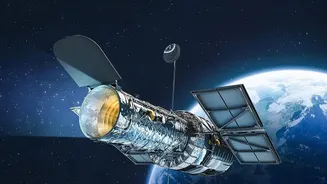
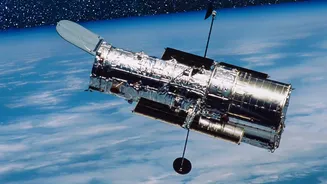
More than a decade later, a team of scientists devised a brilliant new way to probe Ganymede’s interior from afar using the Hubble Space Telescope. Their idea was to observe Ganymede's auroras—the glowing ribbons of electrified gas that form around its poles, just like Earth's northern and southern lights. Because Ganymede is embedded within Jupiter’s powerful magnetosphere, Jupiter's magnetic field causes these auroras to “rock” back and forth as the gas giant rotates. The researchers calculated that if Ganymede were frozen solid all the way through, its auroras should rock by about 6 degrees. However, if a massive liquid ocean was present, its electrical conductivity would create a secondary magnetic field that would counteract Jupiter's pull, dampening the rocking motion significantly.
The Case Is Confirmed
Over several hours of observation, Hubble watched Ganymede's auroras closely in ultraviolet light. The results were clear: the auroral belts barely moved, rocking by only 2 degrees. This was the smoking gun. The suppressed motion was precisely what the models predicted if a huge, salty ocean was sloshing beneath the ice, creating a magnetic drag that stabilized the auroras. This clever use of Hubble confirmed the existence of Ganymede’s ocean, which is estimated to be 100 kilometers thick and buried under a 150-kilometer crust of ice. In fact, scientists believe Ganymede's hidden ocean may contain more water than all of Earth's surface oceans combined.