







A Chemical Assault on Stone
The phrase 'absorbing pollution' describes a relentless chemical assault on the city's heritage. Airborne pollutants, primarily from vehicle exhaust and construction dust, settle on the surfaces of these architectural marvels. Key culprits include particulate
matter (PM2.5), black carbon, sulphur dioxide, and nitrogen oxides. When these particles and gases interact with moisture in the air, they form acidic compounds that react with the stone. For sandstone and marble, this process, known as sulphation, converts the calcium carbonate in the stone into gypsum. This new material is softer, more water-soluble, and traps dirt, leading to the formation of the dark, damaging black crusts seen on many structures.
The Two Main Culprits
The headline points to two primary sources, and scientific studies confirm their role. Delhi's ever-increasing vehicular traffic is a major contributor, releasing not just gaseous pollutants but also heavy metals like lead and zinc, which have been found in the black crusts on the Red Fort. In a city with millions of vehicles, traffic congestion and diesel emissions are a constant source of this corrosive cocktail. Alongside this, the perpetual hum of construction and demolition releases vast quantities of dust into the atmosphere. This dust not only causes physical abrasion but also carries chemical pollutants that stick to monument surfaces, accelerating their decay. In winter, these pollutants become trapped closer to the ground, intensifying the damage.
Monuments Under Siege
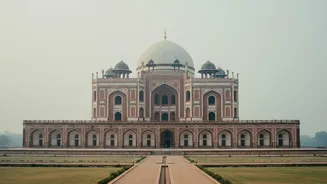
The damage is not abstract; it is visible on Delhi's most cherished landmarks. Recent studies by institutions like IIT Kanpur and IIT Roorkee have provided alarming evidence. At Humayun's Tomb, a UNESCO World Heritage site, researchers found that air pollution is driving the formation of pollutant-rich black crusts on its sandstone surfaces. Similarly, an Indo-Italian study confirmed that the iconic red sandstone walls of the Red Fort are turning black, with crusts up to 0.5 mm thick in high-traffic zones. This is not just discolouration; it's a process that weakens the stone and can cause it to flake off, taking intricate carvings with it. The problem has long been observed at the Taj Mahal in Agra, where pollution has caused its white marble to yellow and require extensive cleaning.
More Than Just a Grimy Facade
The consequences of this pollution extend far beyond aesthetics. The process of chemical decay and crust formation compromises the structural integrity of the stone. As gypsum forms and is washed away by rain, it takes with it a microscopic layer of the original stone, leading to irreversible material loss. Over time, this erosion can weaken the entire structure. For heritage sites that have stood for centuries, this modern, man-made threat is accelerating their decline at an unprecedented rate. It represents a loss of not just architectural beauty but of tangible history, as the very materials of the past are dissolved by the pollutants of the present.
The Battle for Restoration
The Archaeological Survey of India (ASI), the custodian of these monuments, is fighting a difficult battle. Conservation efforts involve painstaking scientific cleaning. One of the most famous methods involves applying a clay pack, similar to multani mitti (Fuller's earth), which absorbs the pollutants and is then washed off, revealing the cleaner surface beneath. However, these are remedial actions, not permanent solutions. Experts stress that while restoration can slow the damage, the only long-term fix is to address the root cause: Delhi's severe air pollution. This requires robust policy implementation, from controlling vehicular emissions to managing construction dust. Without a significant improvement in air quality, the work of conservators will remain a cyclical and ultimately losing fight against the constant deposition of grime.