






A Discovery for the Ages
In the waters near Antalya, a team led by Professor Hakan Öniz from Akdeniz University has unearthed a remarkable piece of history. Lying about 30 metres below the surface is the cargo of an Early Bronze Age merchant ship. While the vessel's wooden hull
has long since disintegrated, its contents tell a story from nearly five millennia ago. The find is being hailed as potentially the oldest known shipwreck in the world, surpassing a 4,200-year-old wreck previously discovered near Dokos, Greece. This places the sinking of the ship around the same time that the Great Pyramid of Giza was being built in Egypt, offering a rare snapshot of a distant era.
An Ancient Cargo Hold
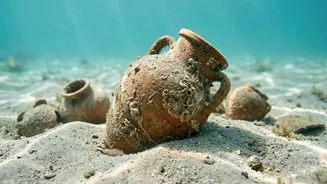
The primary evidence of the ship is its scattered cargo. Archaeologists have catalogued more than 30 ceramic storage jars, known as amphorae, and three large stone anchors. These two-handled jars are distinctive, with a ridge around the middle and a flat base. This specific style was crucial for dating the wreck. Since no wood was left for radiocarbon dating, researchers compared the pottery's design to examples found at sites in Egypt and the Middle East, confidently placing them in the Early Bronze Age, between 4,400 and 4,700 years ago. Remarkably, some of the jars still contain a glossy residue, which is now being analysed to determine if they once held olive oil, wine, or perhaps tree resin.
Mapping Bronze Age Trade
This discovery does more than just set a record for age; it reshapes our understanding of ancient trade. Analysis suggests the clay used for some of the jars originated in the Jordan Valley. This indicates the ship likely started its journey somewhere in the Levant, the region of the eastern Mediterranean that includes modern-day Israel, Jordan, and Lebanon. Researchers theorise the vessel, estimated to be about 10 metres long, was heading west with its valuable cargo, possibly destined for major trade centres like Troy in northwestern Turkey or the Minoan civilisation on Crete. The find is a 'missing piece' in the story of ancient trade, proving that complex maritime networks were active much earlier than previously thought.
Clues to Life at Sea
Among the cargo, one particular amphora has captured special attention. It features two holes and nine distinct markings. Archaeologists have proposed that this may have been a churning vessel, used to make cheese or butter from milk. This raises the fascinating possibility that ancient sailors might have kept live goats aboard their ships on long voyages to provide a source of fresh dairy. If true, this single jar provides an unprecedented insight not just into what was traded, but into the daily lives and resourcefulness of the seafarers who undertook these perilous journeys thousands of years ago.
The Future of the Find
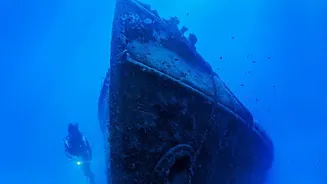
The work at Kekova is far from over. Diving at a depth of 30 metres is challenging, limiting underwater excavation sessions to about 30 minutes at a time. The team from the Mediterranean Archaeology Association is carefully recovering the fragile artefacts for further study. Though the site was first documented a few years ago, its true significance was only recently understood after connecting the pottery styles to other Early Bronze Age finds. The recovered items are slated to be displayed at the upcoming Mediterranean Underwater Archaeology Museum in Antalya, allowing the public to connect with this incredible discovery. For archaeologists, the wreck is a time capsule that promises many more secrets about our shared past.