




The Deep Space Dilemma
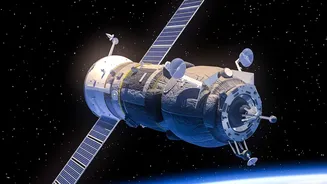
The biggest hurdle for sending astronauts to Mars isn't just distance; it's time. Using current chemical rocket technology, a round trip to the Red Planet could take up to three years. Such a long journey exposes astronauts to prolonged risks, including
dangerous cosmic radiation and the physical toll of zero gravity. Furthermore, these missions require enormous amounts of propellant, which increases the mass of the spacecraft and limits the amount of scientific equipment and supplies that can be carried. This fundamental constraint has pushed space agencies to seek a revolutionary alternative: a faster, more efficient engine for the new age of exploration.
Enter the Nuclear Rocket
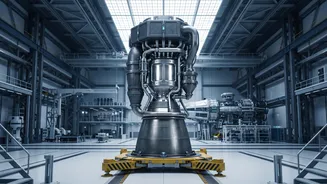
Nuclear thermal propulsion (NTP) offers a compelling solution. Instead of burning fuel with an oxidiser like a chemical rocket, an NTP engine uses a compact nuclear reactor to heat a liquid propellant, like hydrogen, to extremely high temperatures. This superheated hydrogen gas is then expelled through a nozzle to generate powerful thrust. The physics behind it allows for incredible gains in efficiency. An NTP system can be two to five times more efficient than the best chemical rockets, meaning it can travel farther and faster on significantly less propellant. This efficiency is the key to cutting the Mars journey time by up to 25%, a game-changer for human exploration.
A Partnership to Propel the Future
Recognizing this potential, a significant partnership was formed between NASA and the Defense Advanced Research Projects Agency (DARPA). Their joint effort, the Demonstration Rocket for Agile Cislunar Operations (DRACO) program, aimed to design, build, and test a nuclear thermal rocket in space. Under the collaboration, NASA took responsibility for developing the nuclear engine itself, while DARPA managed the overall spacecraft, integration, and approvals. This strategic alliance brought together NASA's deep space exploration goals with DARPA's focus on rapidly advancing new technologies for national security and scientific discovery. Key private sector players like Lockheed Martin and BWX Technologies were brought on board to design and build the spacecraft and its fission reactor, respectively.
The Shifting Landscape of Space Tech
The DRACO program made significant strides, with plans for an in-space demonstration as early as 2027. However, the landscape of space exploration is evolving rapidly. In a significant recent development, DARPA announced it was concluding its involvement in the DRACO project. The decision was driven by a new economic reality: the dramatic and ongoing reduction in launch costs, pioneered by commercial companies like SpaceX. As launching mass to orbit becomes cheaper, the return on investment for developing highly efficient but expensive new propulsion systems like NTP started to look less certain from a defense perspective.
Is the Nuclear Dream Over?
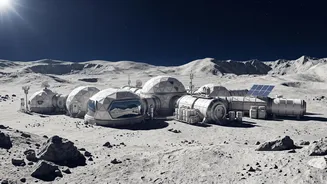
While DARPA's withdrawal marks a major shift for the DRACO program, it does not spell the end for nuclear propulsion research. NASA's interest in the technology as a primary capability for its 'Moon to Mars' objectives remains strong. The knowledge and progress from the DRACO collaboration are being transitioned to NASA, which continues to explore various space nuclear technologies, including both nuclear thermal and nuclear electric propulsion (NEP). NEP systems offer even greater propellant efficiency over long periods, though with lower thrust, and could be vital for deep space robotic missions. The focus now shifts to how NASA will carry this critical research forward, potentially with new partners, as it still represents one of the most promising pathways to making humanity a multi-planetary species.