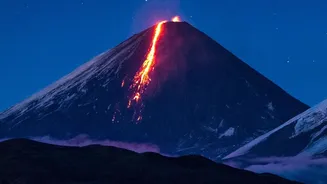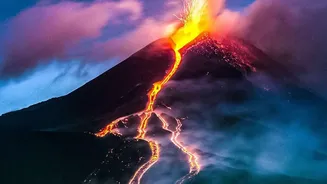


Eyjafjallajökull, Iceland (2010): The Ash Cloud That Halted Air Travel
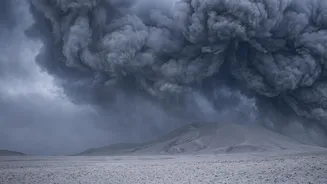
Many people first learned to pronounce 'Eyjafjallajökull' in April 2010, not for the size of the eruption, but for the scale of its disruption. When this Icelandic volcano erupted under a glacier, the resulting plume of fine, abrasive ash was carried
directly into some of the busiest airspace in the world. Concerns that the glassy, silicate particles in the ash could melt inside jet engines and cause them to fail led to a decision that was unprecedented in modern times: the closure of vast swathes of European airspace for six days. The effect was immediate and chaotic. It was the largest shutdown of air traffic since World War II, cancelling over 100,000 flights and stranding some 10 million passengers globally. The economic toll was immense, with airlines losing an estimated $1.7 billion in revenue. The event served as a stark wake-up call, demonstrating how a single, moderately sized eruption in the right (or wrong) place could sever the arteries of global travel and commerce overnight.
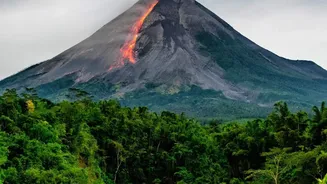
Mount Merapi, Indonesia (2010): A Story of Local Devastation
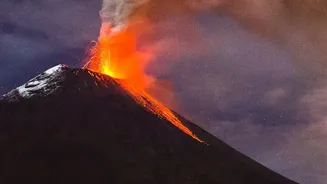
While Eyjafjallajökull’s impact was largely economic and logistical, the eruption of Mount Merapi in Indonesia in late 2010 was a human tragedy. As one of the most active and dangerous volcanoes in the world, Merapi sits in a densely populated region of Java. The series of eruptions that began in October were the volcano's most powerful in over a century. Superheated avalanches of gas and rock, known as pyroclastic flows, swept down the mountainside at terrifying speeds, burying entire villages. The disaster claimed the lives of nearly 400 people and forced the evacuation of over 350,000 residents from their homes. The ashfall crippled agriculture, a primary source of livelihood for many, and evacuation centres became dangerously overcrowded. Merapi’s eruption was a powerful reminder of the immediate and deadly threat volcanoes pose to the communities living in their shadow, a reality for millions across the Pacific Ring of Fire.
Puyehue-Cordón Caulle, Chile (2011): An Ash Plume That Circled the Globe
Less than a year after Iceland’s aviation shutdown, the Southern Hemisphere experienced its own volcanic travel chaos. The eruption of the Puyehue-Cordón Caulle volcanic complex in Chile sent a colossal ash plume high into the atmosphere that was so large it circled the globe in about two weeks. This disrupted aviation on a planetary scale, forcing flight cancellations not just in South America but as far away as Australia and New Zealand. The eruption ejected an estimated 100 million tons of ash, sand, and pumice. While the immediate evacuation zone was limited to a few thousand people, the widespread ashfall had severe impacts on agriculture, livestock, and infrastructure across Patagonia. The event highlighted that the effects of a major eruption are not confined by geography; the atmosphere connects us all, and what goes up in one continent can have serious consequences on another.
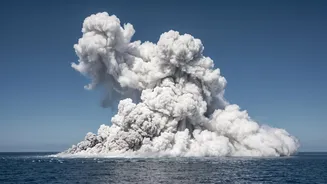
Hunga Tonga-Hunga Haʻapai, Tonga (2022): The Explosion That Reached for Space
The eruption of the Hunga Tonga-Hunga Haʻapai underwater volcano on January 15, 2022, was a truly historic event. It was the largest explosive eruption of the 21st century and the most powerful ever recorded by modern instruments, with a force hundreds of times stronger than the atomic bomb dropped on Hiroshima. The blast generated an atmospheric shockwave that travelled around the world multiple times and triggered a devastating tsunami that hit Tonga and was detected across the Pacific Ocean. Uniquely, because it was an underwater eruption, it blasted an unprecedented amount of water vapour—an estimated 150 million tons—into the stratosphere. This massive injection of water, a greenhouse gas, had scientists concerned about its potential to temporarily warm the planet's surface, increasing the odds of briefly crossing the 1.5°C warming threshold. Later analysis showed the overall climate effects were minor, but the eruption provided a unique look at how water-rich volcanoes can impact atmospheric chemistry and ozone. The event also severed a vital undersea communication cable, cutting Tonga off from the rest of the world and highlighting a critical vulnerability of our digital age.