



A Tale of Cosmic Cannibalism
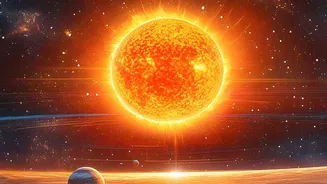
The fundamental idea is a dramatic part of stellar evolution. Stars like our sun are stable for billions of years, but they don't live forever. Once they exhaust the hydrogen fuel in their core, they begin to die. This process causes them to swell dramatically,
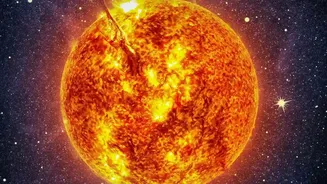
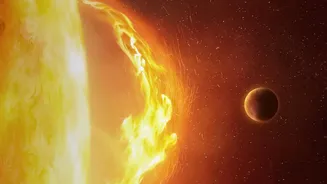
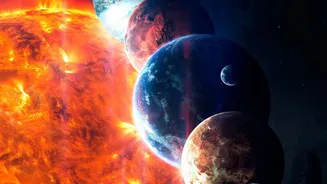
becoming a 'red giant'. A red giant can expand to hundreds of times its original size. For any planets orbiting closely, this is a death sentence. The star's expanding outer atmosphere can drag a planet inward, ultimately consuming it entirely. For years, astronomers have predicted this fate for countless worlds across the galaxy, including the inner planets of our own solar system.
The Chemical Fingerprints
Without seeing an engulfment happen, scientists had to become cosmic detectives, searching for clues left behind. The most powerful evidence came from a star's chemistry. Stars are mostly hydrogen and helium. Heavier elements, which astronomers call 'metals', are less common. Rocky planets, however, are made of these heavier elements. The theory was that if a star swallowed a rocky planet, its atmosphere would be temporarily 'polluted' with elements like iron, silicon, and especially lithium, which is otherwise quickly destroyed inside a star. By comparing the chemical makeup of twin stars born from the same cloud, astronomers found cases where one twin had unusual amounts of these elements, suggesting it had eaten a planetary meal that its sibling had not.
Why It Wasn't Proof
These chemical signatures were compelling, but they remained indirect evidence. It was a strong correlation, but not definitive causation. Scientists had to build models to show how consuming a planet of a certain mass would produce the observed chemical changes. While these models were powerful and matched the data well, there was always a small chance that other, unknown stellar processes could create similar results. To truly prove the theory, astronomers needed more than a chemical fingerprint left at the scene; they needed to catch a star in the act. They needed a direct detection.
The First Smoking Gun
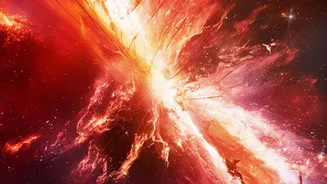
That groundbreaking moment came recently. An event named ZTF SLRN-2020, located about 12,000 light-years away, provided the first direct evidence of a star devouring a world. Astronomers observed a star that suddenly brightened by over a hundred times. This wasn't a typical nova; observations showed it was surrounded by cooler gas and dust. Data from multiple telescopes, including NASA's NEOWISE spacecraft, revealed that dust had started forming around the star about a year before the main flash, suggesting a planet was being torn apart as it spiraled inward. The final plunge triggered the massive outburst of light and energy—the 'smoking gun' that had been predicted for decades.
A Glimpse of Earth's Fiery Future
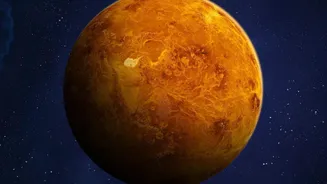
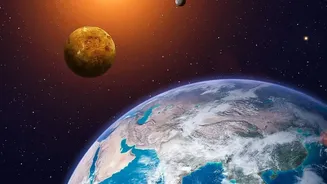
This research isn't just about distant stars; it's a preview of our own solar system's destiny. In about five billion years, our Sun will exhaust its hydrogen fuel and begin its transformation into a red giant. It is expected to expand so much that it will engulf Mercury and Venus. For a long time, Earth's fate was uncertain, with some models predicting it would be swallowed and others that it might just escape. Even if Earth narrowly avoids being consumed, the intense heat from the bloated Sun will have long since boiled away our oceans and stripped our atmosphere, rendering the planet a lifeless, charred rock. The direct observation of planetary engulfment validates the models that predict this ultimate fate, moving it from the realm of theory to observed reality.