


The Case of the Missing Moon
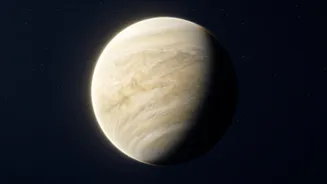
For decades, scientists have puzzled over why Venus is moonless while Earth has a prominent companion. The two planets are similar in size, mass, and structure, suggesting they might have formed under similar conditions. The leading theory for our own
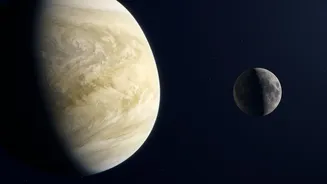
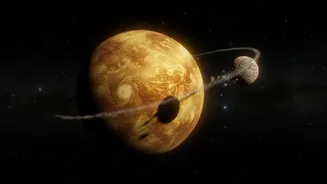
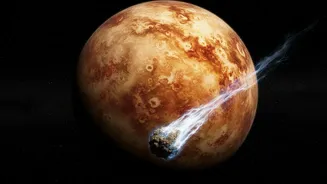
Moon's formation involves a giant impact with a Mars-sized object early in the solar system's history. Previous ideas for Venus suggested either that it was hit by another large object that destroyed its moon, or that it simply avoided a moon-forming collision altogether. However, recent computer simulations from the University of California, Riverside, offer a more dramatic and internally driven explanation: Venus may have devoured its own moon.
A Planet Spinning in Slow Motion
The key to this cosmic drama is Venus's bizarre rotation. A day on Venus lasts 243 Earth days, which is longer than its year of 225 Earth days. It also spins backwards compared to most other planets in our solar system. This sluggish, retrograde spin is the complete opposite of Earth's brisk 24-hour rotation. The reasons for this are complex, but are thought to involve a combination of factors, including the powerful gravitational pull of the Sun and the planet's incredibly thick, fast-moving atmosphere, which drags on the surface and slows it down.
The Physics of a Death Spiral
This slow spin has profound consequences for any potential moon. On Earth, our planet rotates faster than the Moon orbits it. This causes the tidal bulges raised by the Moon's gravity on Earth's oceans and crust to pull slightly ahead of the Moon. This interaction transfers rotational energy from the Earth to the Moon, pushing it farther away at a rate of about 1.6 inches per year. However, the simulations suggest the opposite would happen at Venus. Because Venus spins so slowly, its tidal bulge would lag behind a hypothetical moon. Instead of pushing the moon away, this would steal orbital energy from the moon, causing it to spiral slowly but inevitably inward toward the planet.
What the Simulations Revealed
To test this idea, astrophysicist Stephen Kane and his team ran a series of computer models. They first validated their simulation by accurately recreating the Earth-Moon system's evolution. Then, they applied it to Venus, testing a wide range of scenarios with different initial rotation speeds and hypothetical moons of varying masses. The results were striking. In most simulations, the outcome was the same: the moon crashed into Venus. Larger moons, which would exert a stronger tidal force and slow Venus's rotation even more, actually hastened their own demise, spiraling into the planet even faster.
An End Erased by Time
While the simulations show that Venus could not have kept a moon it may have had, they don't prove one ever existed. Finding direct physical evidence of such a colossal impact is incredibly difficult. Around a billion years ago, Venus appears to have undergone a massive global resurfacing event, with widespread volcanism paving over much of its older geological history. This event would have likely erased any crater or surface evidence of a moon collision. Any remaining clues may be hidden deep within the planet's interior, which could potentially be studied with future seismic missions. The destruction of a moon could have even played a role in triggering the runaway greenhouse effect that turned Venus into the inferno it is today.