

The Universe's Biggest Mystery
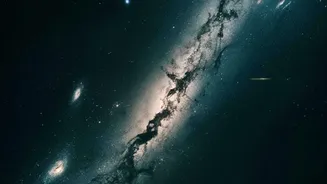
For nearly a century, astronomers have known something was missing. Galaxies spin so fast they should fly apart, but they don't. Clusters of galaxies hold together with more gravitational force than their visible matter can explain. The culprit is thought
to be dark matter, an invisible 'glue' that doesn't emit, absorb, or reflect light. Scientists estimate that this mysterious substance accounts for about 27% of the universe, forming a vast, unseen scaffold upon which the cosmic web of galaxies is built. While we have overwhelming indirect evidence for its existence, we have never detected it directly. It remains one of the greatest puzzles in modern science, hinting at new physics beyond our current understanding.
A New Eye on the Cosmos
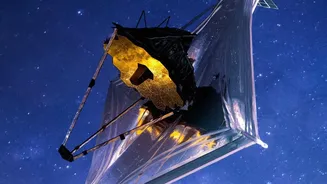
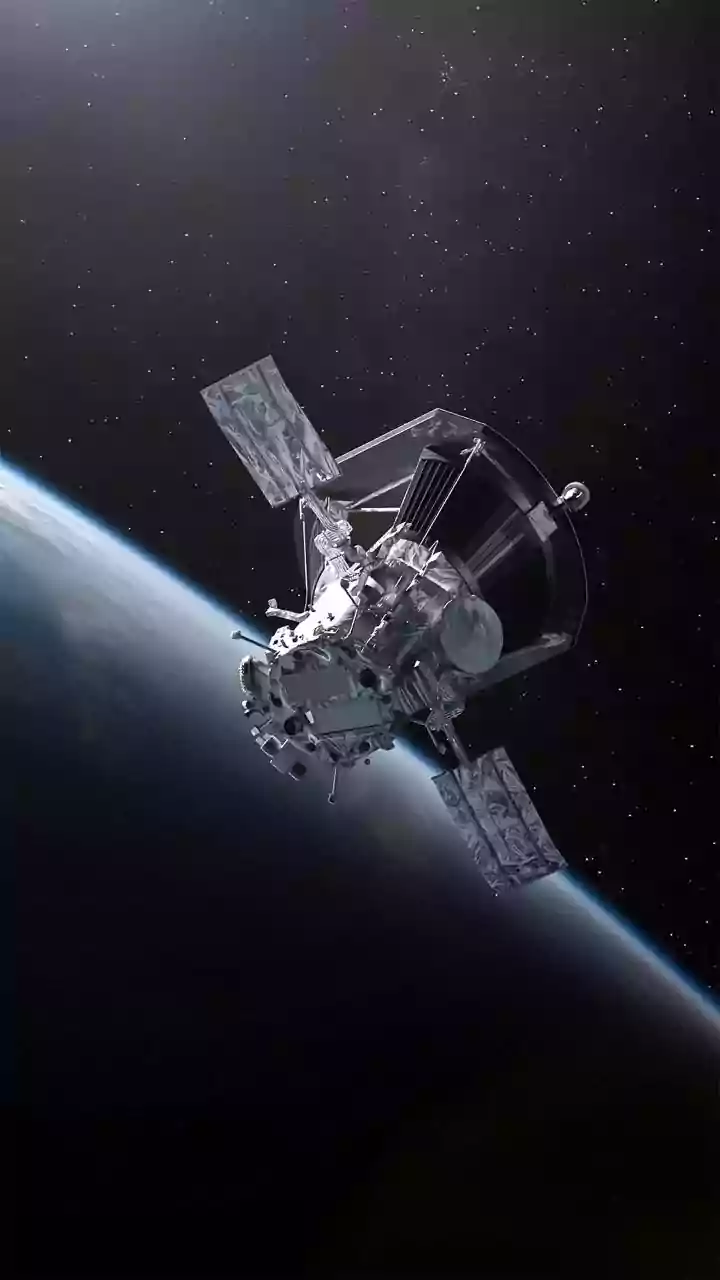
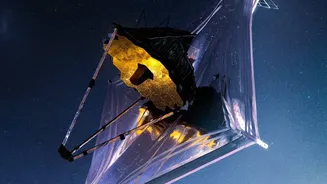
Enter the Nancy Grace Roman Space Telescope. Launched on August 30, 2026, this next-generation NASA observatory is poised to revolutionize astronomy. Named after NASA's pioneering first chief of astronomy, Roman is a flagship mission on the same scale as the Hubble and James Webb space telescopes. After a journey of approximately 100 days, it will begin its work from a stable orbit 1.5 million kilometres from Earth. While its mission includes discovering thousands of new exoplanets and studying the dark energy that accelerates the universe's expansion, one of its primary goals is to tackle the dark matter enigma head-on.
How to See the Unseeable
So, how does a telescope see something that's defined by its invisibility? Roman will use a clever trick of nature predicted by Albert Einstein: gravitational lensing. According to Einstein's theory of general relativity, massive objects warp the fabric of spacetime, causing light to bend as it passes by. Dark matter has mass, so its immense gravity acts like a cosmic magnifying glass, distorting the light from more distant galaxies. These distortions, though often tiny, are measurable. By observing the subtle, warped shapes of millions of galaxies, scientists can work backward to map the location and concentration of the invisible matter causing the lensing effect.
A Panoramic View Like Never Before
This is where Roman's key advantage comes into play. Its Wide-Field Instrument can capture an area of the sky 200 times larger than Hubble's infrared camera in a single snapshot, all while maintaining a similar sharpness. This vast field of view allows the telescope to create enormous 3D maps of the universe's structure far more efficiently than its predecessors. Over its planned five-year primary mission, Roman will survey billions of galaxies, identifying how their distribution has changed over cosmic time. By analyzing the weak lensing effects across these immense datasets, astronomers will create the most detailed maps of dark matter distribution ever produced, revealing its clumpy, web-like structure on an unprecedented scale.
Rewriting the Cosmic Map
These detailed maps won't just show us where the dark matter is; they will help us understand what it is. Different theories about the nature of dark matter particles predict different levels of 'clumpiness' on small scales. By measuring the precise distortions in lensed galaxies with incredible accuracy, Roman can test these theories. The data could help distinguish between leading candidates, such as massive, slow-moving particles (WIMPs) or other exotic possibilities. With its first science images expected in early 2027, the Roman Space Telescope is on the cusp of providing the clues needed to illuminate one of the darkest secrets of the cosmos.