







The Next Great Alien Hunter
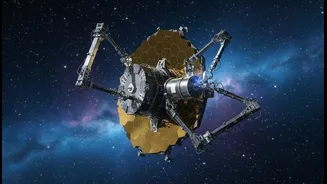
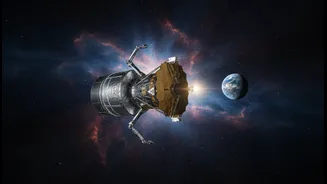
The Habitable Worlds Observatory, or HWO, is NASA’s next flagship astrophysics mission, slated to launch in the 2040s. Following in the footsteps of giants like the Hubble and James Webb Space Telescopes, its primary goal is breathtakingly ambitious:
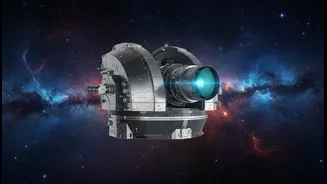
to directly image and study at least 25 Earth-like planets orbiting other stars. HWO will be the first telescope designed specifically for this purpose, using its powerful optics to scan the atmospheres of these distant worlds for biosignatures—chemical hints of life, such as oxygen and methane. This $11 billion observatory represents a monumental investment in the search for life in the cosmos, building on decades of discovery to probe fundamental questions about our place in the universe.
A Prime Piece of Celestial Real Estate
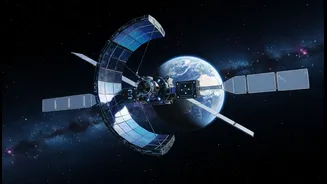
To achieve its goals, HWO needs a perfect vantage point. It will be positioned at the second Sun-Earth Lagrange Point, known as L2, a spot in space roughly 1.5 million kilometres (nearly a million miles) from Earth. A Lagrange point is a special location where the gravitational pull of two large bodies, in this case the Sun and Earth, precisely balances the centrifugal force of a smaller object. This allows a spacecraft to effectively 'park' in a fixed position relative to Earth as they both orbit the Sun. L2 is ideal for astronomy because it offers an uninterrupted view of deep space. A telescope there can keep the Sun, Earth, and Moon all in one direction, allowing its sensitive instruments to stay incredibly cold and free from the thermal radiation and stray light that can interfere with observations.
The Tyranny of Distance
While L2 is a paradise for a telescope, it's a nightmare for maintenance crews. The location is about four times farther away than the Moon. The iconic Hubble Space Telescope, which orbits just a few hundred kilometres above Earth, was famously saved and upgraded multiple times by astronauts on Space Shuttle missions. Those kinds of hands-on repairs are simply not feasible for HWO. The immense distance makes a human mission incredibly risky, time-consuming, and prohibitively expensive with current technology. The James Webb Space Telescope, which also operates at L2, was designed as a single-life mission with no servicing capabilities. If a critical component failed, it would be the end of the mission. For an observatory as expensive and important as HWO, that's a risk NASA is unwilling to take.
Enter the Robotic Mechanics
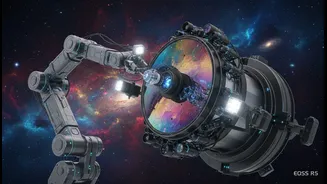
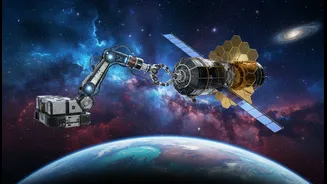
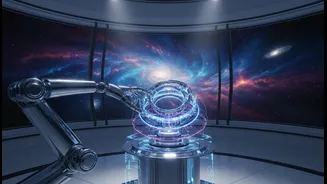
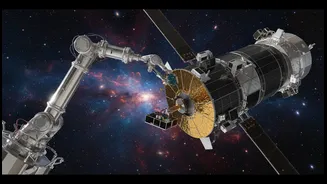
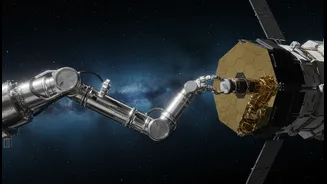
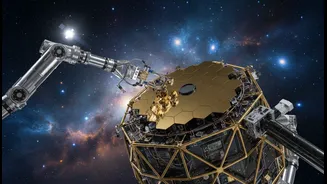
The solution is to take humans out of the equation. HWO is being designed from its very foundation to be serviced, repaired, and upgraded entirely by robots. This represents a fundamental shift in how we build our most advanced scientific instruments for space. Future robotic servicing spacecraft will be dispatched to HWO to perform a range of complex tasks. These could include refueling its propulsion systems, replacing worn-out or damaged components, and—most importantly—swapping out old scientific instruments for newer, more capable technology as it becomes available. This approach turns the observatory from a disposable asset into a sustainable, long-term platform for discovery.
A New Blueprint for Space Exploration
The mandate for robotic servicing is about more than just keeping HWO running; it signals a new strategy for the business of space exploration. NASA and its commercial partners are already proving the concept. The OSAM-1 mission is developing a robotic arm designed for dexterous in-orbit operations, and the recent LINK mission successfully launched to give a robotic boost to the aging Swift Observatory. By making HWO modular and robot-friendly, NASA is ensuring its flagship mission can evolve over its decades-long lifespan. If HWO finds a tantalizing hint of life on a nearby exoplanet, there will be immense motivation to quickly equip it with even better instruments. Robotic servicing makes that possible, ensuring our most powerful eyes on the universe remain sharp for generations to come.