
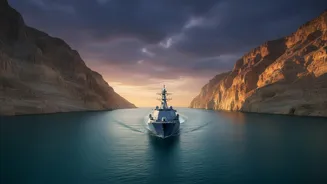
The World's Most Important Waterway
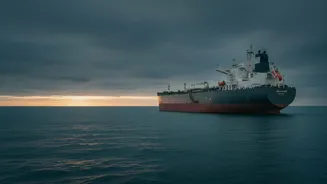
The Strait of Hormuz is arguably the world's most critical maritime chokepoint. Connecting the Persian Gulf to the open ocean, it is the primary route for a vast portion of global energy supplies. Approximately 20-25% of the world's total seaborne oil
trade passes through this narrow channel every day. In addition, nearly 20% of global liquefied natural gas (LNG), primarily from Qatar, transits the strait. Its importance is so profound that any disruption has immediate and severe consequences for the global economy, capable of sending energy prices soaring and disrupting supply chains for everything from fuel to fertilizers. This immense strategic value also makes it a focal point of regional and international tension, particularly between the US and Iran.
A Flashpoint for Conflict
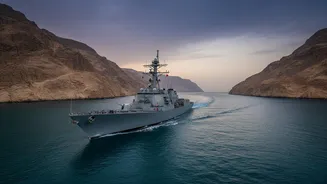
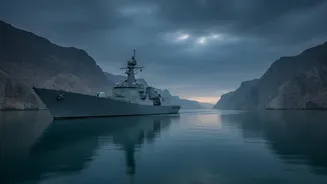
The waters of the Strait have long been a theatre for confrontation. In recent years, tensions have repeatedly flared, with incidents including the seizure of commercial tankers, attacks on vessels, and tense encounters between Iran's Islamic Revolutionary Guard Corps (IRGC) Navy and the US Navy. Conflicting claims over passage rights and security protocols have led to a volatile and unpredictable environment. Recent events in 2026 have underscored this fragility, with shipping nearly coming to a standstill amid military escalations. Washington has imposed sanctions on Iranian entities attempting to regulate and charge for passage, while Tehran insists on its right to administer traffic through waters it considers vital to its national security. This cycle of military posturing, blockades, and retaliatory strikes has created a high-stakes environment where a single miscalculation could have devastating consequences.
The Missing 'Rules of the Road'
This is the crux of the problem for any lasting diplomatic agreement. A nuclear deal, while significant, does not address the fundamental issue of maritime security in the Strait. Without a clear, mutually agreed-upon framework for naval conduct and commercial transit, the potential for conflict remains dangerously high. Currently, there is no shared understanding of the 'rules of the road'. Iran and the US have promoted competing routes and protocols, creating confusion and risk for commercial shipping. For a deal to be sustainable, it would need to include what are known as deconfliction mechanisms—clear communication channels and protocols to prevent accidental escalation between naval forces. This might involve establishing specific, safe transit corridors, creating crisis communication hotlines, and agreeing on procedures for approaching and identifying other vessels. Without this, any broader accord would be built on a foundation of constant maritime risk.
Why Hormuz Matters to India
For India, the stability of the Strait of Hormuz is not a distant geopolitical issue; it is a matter of vital national interest. A significant majority—by some estimates, more than two-thirds—of India's crude oil imports pass through this chokepoint. Any disruption, closure, or spike in insurance and shipping costs due to conflict in the Strait has a direct and immediate impact on India's energy security, leading to higher inflation and economic strain. This reliance has prompted New Delhi to take an active role in the region's security, deploying its own naval assets under 'Operation Sankalp' to escort Indian-flagged vessels and protect its energy lifelines. Furthermore, the Gulf region is home to a large Indian diaspora, and ensuring their safety and the stability of trade routes is a paramount concern. Therefore, any US-Iran agreement that fails to secure freedom of navigation in the Strait leaves India's economic and strategic interests vulnerable.