





A New Window on the Cosmos
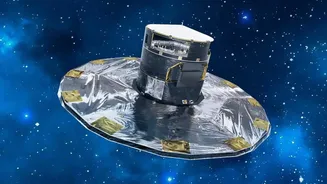
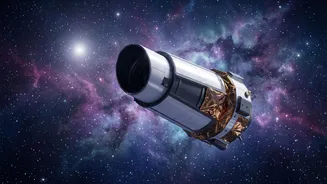
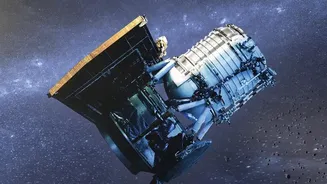
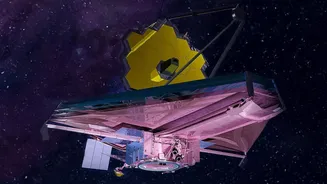
Successfully launched in late August 2026, the Nancy Grace Roman Space Telescope is NASA's next great observatory, poised to revolutionize our understanding of the universe. Named after Nancy Grace Roman, NASA's first chief of astronomy and the “Mother
of Hubble,” this new mission is designed to tackle some of the biggest questions in astrophysics. Its primary goals are to hunt for the secrets of dark energy and dark matter, discover thousands of new exoplanets, and provide breathtaking infrared views of the cosmos. After its launch, the telescope embarked on a journey to its observation point about 1.5 million kilometers from Earth, a location known as the sun-earth Lagrange Point 2, where it will operate alongside the James Webb Space Telescope. Now undergoing its commissioning phase, Roman is expected to begin its full science operations in early 2027, ushering in a new era of cosmic discovery.
The Power of a Wide View
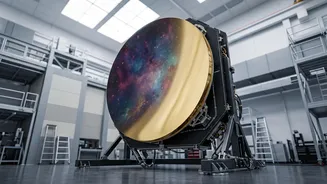
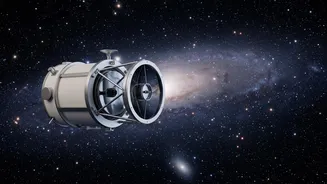
What makes the Roman telescope so special is its incredible field of view. While its 2.4-meter primary mirror is the same size as Hubble's, its Wide Field Instrument (WFI) can see an area of the sky at least 100 times larger. This means a single image from Roman can contain the detail of 100 separate Hubble images. Think of it as the difference between looking at the sky through a keyhole versus a giant panoramic window. This capability comes from its powerful 300-megapixel camera, which will capture vast stretches of the universe with the same sharp resolution that made Hubble famous. This wide-angle lens allows Roman to survey the sky up to 1,000 times faster than Hubble, enabling it to map billions of galaxies and stars during its five-year primary mission.
Hunting for Cosmic Mysteries
Roman’s expansive view is purpose-built to investigate two of the most profound puzzles in science: dark energy and exoplanets. To study dark energy—the mysterious force causing the universe's expansion to accelerate—Roman will systematically map the positions and distances of millions of galaxies and supernovae. By creating a massive 3D map of the cosmos, scientists can trace the history of cosmic expansion with unparalleled precision. Simultaneously, Roman will conduct the largest census of planets outside our solar system. Using a technique called gravitational microlensing, it can detect planets that are too small or too distant to be found by other methods, including rogue planets that drift through space without a host star. It is expected to discover over 100,000 new exoplanets, dramatically expanding our catalogue of known worlds.
A Complement to Hubble and Webb
Roman is not a replacement for Hubble or the James Webb Space Telescope (JWST), but a powerful new partner in NASA's fleet of observatories. The three telescopes have complementary capabilities. Where JWST excels at making extremely deep, focused observations of small patches of sky, and Hubble provides sharp images across a broad light spectrum, Roman acts as the master surveyor. It will identify countless new and intriguing targets—from unusual galaxies to potential life-hosting planets—that Hubble and Webb can then study in greater detail. One NASA scientist compared them to photographers in a forest: Hubble and Webb zoom in on a single leaf or bird, while Roman provides the stunning, wide-angle shot of the entire forest, capturing the context that makes the individual discoveries even more meaningful.
A New Generation of Discovery
Beyond its primary goals, Roman is equipped with a technology demonstrator called the Coronagraph Instrument. This advanced tool is designed to block the overwhelming glare from stars, allowing the telescope to directly image giant exoplanets orbiting them—a feat that has been incredibly difficult until now. The technology being tested on Roman's coronagraph will pave the way for future missions, like the planned Habitable Worlds Observatory, which aims to find Earth-like planets and search for signs of life. All of Roman’s data will be made public immediately, creating a treasure trove for astronomers around the world. The sheer volume of information will fuel scientific discovery for decades, ensuring that Nancy Grace Roman’s legacy of exploration continues far into the future.