



Meet the Cosmic Lion
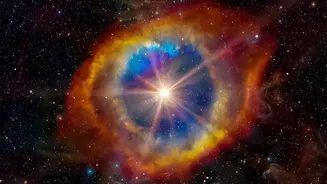
The Lion Nebula, officially known as NGC 2392, is a planetary nebula located thousands of light-years from Earth. Don't let the name fool you; it has nothing to do with planets. Instead, it's the beautiful, glowing shell of gas and dust cast off by a star
similar to our Sun as it reached the end of its life. For thousands of years, this expelled material has been expanding into space. At the nebula's heart, looking like a button nose, sits the extremely hot remnant of the star—a white dwarf. This stellar core is the engine driving the entire spectacle.
Webb's Powerful Infrared Gaze
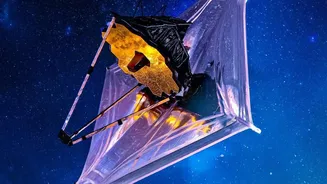
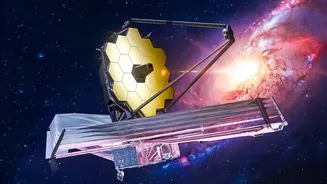
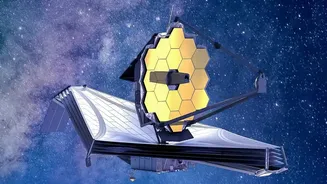
While the Hubble Space Telescope gave us memorable views of the Lion Nebula in visible light, the James Webb Space Telescope's power lies in its ability to see in infrared. This allows it to peer through the obscuring outer layers of dust and gas to reveal hidden structures with stunning clarity. Webb's near- and mid-infrared cameras, NIRCam and MIRI, work together to capture details that were previously invisible, giving astronomers a much sharper look at how the nebula is being shaped. The result is not just a new image, but a deeper understanding of the physical processes at play.
The Sculptors: Radiation and Wind
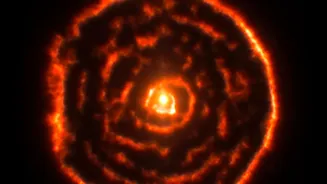
So, how does a spherical star create such a complex, sculpted structure? The answer lies in the intense energy blasting from the central white dwarf. This dying star is so hot that its radiation effectively 'cooks' the nebula from the inside out, creating a massive bubble of superheated, ionized gas. This bubble makes up the 'face' of the lion. As this bubble of gas expands outward, it acts like a cosmic snowplow, pushing and carving the surrounding material. This process creates the intricate shells, rings, and tendrils that give the nebula its lion-like appearance, including its flowing 'mane'. This mane is an interior shell of dust being illuminated by the star.
Decoding the Cosmic Colors
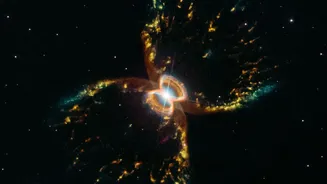
The colors in Webb's images are not what our eyes would see; they are translations of different infrared wavelengths into a visible spectrum. Each color tells a scientific story. In this portrait of the Lion Nebula, cyan and purple hues highlight the 'mane', showing a shell of dust lit up by the central star. Within this mane, fluffy purple clumps show where dust has managed to survive the star's onslaught, protecting the material behind it. In composite images combining different infrared views, yellow can indicate molecular hydrogen, while reds and oranges show other concentrations of surviving dust. This color-coding allows scientists to map the chemistry and temperature across the nebula with incredible precision.
A Snapshot of Cosmic Recycling
The Lion Nebula is a snapshot of a dynamic, evolving process that will only last for about 10,000 years before the gas and dust disperse completely—a blink of an eye in cosmic terms. This new portrait from Webb provides crucial insights into how stars die and how they enrich the universe with new materials. The very dust and gas being sculpted by the dying star are the raw ingredients from which future stars and planets will be born. By studying how the central star’s radiation both destroys and illuminates the surrounding dust, astronomers can better understand the lifecycle of matter in our galaxy and the complex interplay that shapes the cosmos.