




A Neighbor Under the Microscope
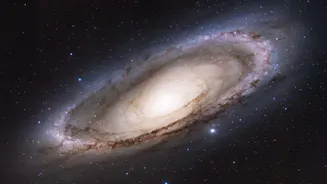
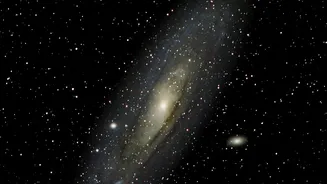
At just 2.5 million light-years away, the Andromeda galaxy is a cosmic neighbor we can see with the naked eye from a dark-sky location. For astronomers, its proximity makes it the perfect laboratory for studying how large spiral galaxies like our own
Milky Way live and die. A recent study has provided the most detailed look yet into Andromeda's past, and the findings are striking: the galaxy's once-vibrant star-making machinery is slowing down significantly. After a major burst of activity about two billion years ago, likely from a galactic merger, Andromeda has been on a steady path of decline. This new research gives us a front-row seat to the gradual, quiet end of a galaxy's most productive years.
Reading the Fossil Record of Stars
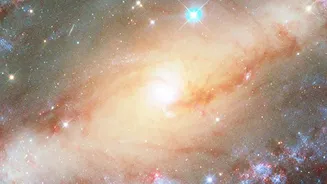
To create these new maps, astronomers combined data from two of Hubble's largest-ever surveys of Andromeda, known as the Panchromatic Hubble Andromeda Treasury (PHAT) and its southern counterpart, PHAST. Together, these projects mapped about two-thirds of the galaxy's sprawling disk, measuring the light from nearly 200 million individual stars. The key was to look at the stars' colors. Massive, young stars burn hot and bright, giving off a distinct blue light, but they live short lives. Older, less massive stars are cooler and glow with a redder hue. By analyzing the ratio of blue to red stars across thousands of different regions, scientists could effectively create a stellar "fossil record," revealing where and when star birth was most active over hundreds of millions of years.
A Tale of Two Rings
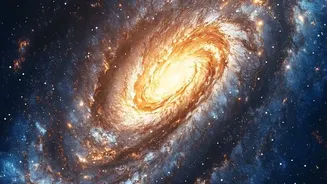
The results show a dramatic slowdown. About 500 million years ago, Andromeda was creating stars at a rate of roughly one solar mass per year. By 40 million years ago, that rate had been cut in half. Today, it has plummeted to just one-fifth of a solar mass annually. But this decline isn't happening uniformly. The maps reveal that most of Andromeda's recent star-making activity has been concentrated in a prominent ring about 32,000 light-years from the galactic center. This vibrant area stands in stark contrast to the rest of the galaxy, where star formation has largely ceased. Much of the overall decline is driven by the fading of activity within this very ring, as the galaxy's creative spark slowly dims.
Why Are the Stellar Nurseries Closing?
Intriguingly, the slowdown doesn't appear to be caused by a lack of raw materials. Andromeda still has plenty of gas and dust from which to form new stars. Instead, astronomers believe the galaxy is simply in a natural winding-down phase after its more energetic youth. As lead author Tobin Wainer described it, “It's just like after running a marathon, sometimes you've got to take a bit of a breather.” There may be another culprit involved, however. Researchers also suspect that Andromeda's small companion galaxy, Messier 32 (M32), could be playing a role. They found a noticeable decrease in star formation in the area near M32, suggesting a past interaction might have disrupted local star-forming regions.
A Glimpse of Our Own Future
Studying Andromeda's life cycle isn't just an academic exercise; it provides crucial clues about the long-term evolution of our own Milky Way. By watching our neighbor enter its quieter years, we can better understand the forces that will shape our galaxy's destiny. This is especially relevant given that the Milky Way and Andromeda are on a collision course, set to merge in about 4.5 billion years. Understanding why Andromeda's stellar nurseries are closing down could help predict the fate of our own home galaxy long after that cosmic smash-up. These new maps are a testament to the power of telescopes like Hubble to piece together the grand, sweeping histories written in the stars.