




The Capsule at the Core
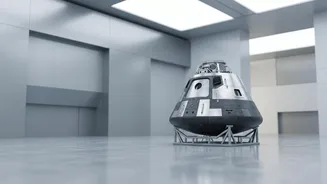
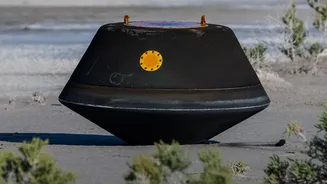
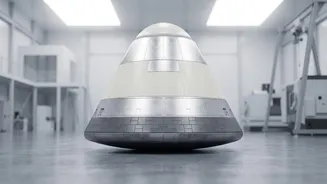
At the heart of India's ambitious Gaganyaan human spaceflight programme is the Crew Module—the pressurised capsule where astronauts will live and work. This module is far more than just a cabin; it's a multi-functional vehicle designed to withstand the violent
vibrations of launch, provide a life-sustaining environment in the vacuum of space, and survive a fiery re-entry through Earth's atmosphere. Ensuring this capsule can protect its occupants in every conceivable scenario is the single most important objective for the Indian Space Research Organisation (ISRO). To do this, engineers don't just rely on simulations. They conduct what are known as qualification tests, where systems are pushed harder on the ground than they would ever be in an actual flight, proving their right to fly.
Test One: A Clean Break and a Strong Shield
Two of the recently completed tests focus on critical separation events that happen in fractions of a second but are vital for mission success. One test validated the clean separation of the 'umbilical' cord that connects the Crew Module to its Service Module. This connection provides power and life support during orbit, but it must disconnect flawlessly before the capsule begins its descent. A failure here could be catastrophic. Another test confirmed the module's structural strength when the Apex Cover is jettisoned. This cover protects the parachute system during launch and re-entry. To deploy the parachutes, this cover is blasted away using pyrotechnics. ISRO engineers tested the Crew Module's structure by subjecting it to forces 1.75 times greater than those expected during this event, confirming its design integrity.
Surviving the Splashdown
A successful mission ends with a gentle splashdown in the sea, but the ocean is not always a calm host. Waves can easily tip the capsule over, making it difficult for astronauts to exit or for recovery crews to secure it. To solve this, ISRO developed the Crew Module Up-righting System (CMUS). This system uses inflatable balloons, powered by stored cold gas, to automatically flip the capsule back into an upright position if it lands inverted. Recent qualification tests saw the full system being deployed, with gas from high-pressure bottles successfully inflating the floats and proving the system is ready to ensure a safe and stable post-landing orientation for the crew.
Test Three: The Art of the Airdrop
Perhaps the most visually striking tests involve the parachute system, which is the key to slowing the capsule from hypersonic speeds to a safe landing velocity. In a series of Integrated Main Parachute Airdrop Tests (IMAT), a simulated Crew Module is dropped from an Indian Air Force aircraft at high altitude. These tests validate the complex, ten-parachute sequence, which includes drogue chutes for initial stabilisation and massive main parachutes for the final deceleration. A recent test in April 2026 saw a 5.7-tonne simulated module dropped from 3 km, successfully testing the deployment sequence needed to bring the real capsule to a gentle touchdown in the sea. These airdrops provide powerful visuals of the giant parachutes blossoming, transforming the abstract concept of safety into a tangible reality.
A Visual Narrative of Confidence
While engineering data is paramount, the images and videos from these tests serve a second, equally important purpose: building public trust. Watching the escape system fire, seeing the flotation bags inflate, or witnessing the majestic unfurling of the main parachutes gives the entire nation a front-row seat to the safety protocols in action. It demystifies the complex process of human spaceflight and provides a powerful, visible narrative of ISRO's commitment to crew safety. These tests are not just technical hurdles being cleared; they are demonstrations of capability and confidence. Each successful trial brings India one step closer to the day it joins the elite club of nations—currently just the US, Russia, and China—that have sent their own citizens into space.