



What Exactly Is a 'Fire Rainbow'?
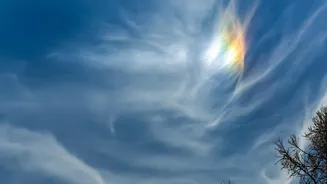
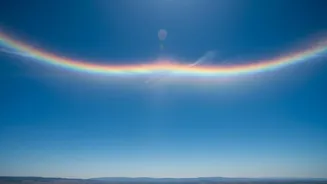
The captivating display often called a 'fire rainbow' is known to scientists as a circumhorizontal arc. It's part of a family of optical phenomena called ice halos, which are created by the interaction of light with ice crystals in the atmosphere. Unlike
a true rainbow, which is formed by the refraction and reflection of light in water droplets, a circumhorizontal arc owes its existence entirely to ice. The name is misleading; it's not a rainbow and certainly not related to fire, though the wispy, flame-like appearance of the cirrus clouds where it forms makes the name understandable. In its full form, it appears as a broad, colourful band running parallel to the horizon, often so large that only fragments are visible.
The Three Crucial Ingredients
Seeing a circumhorizontal arc is rare because it requires a precise combination of three conditions. First, the sun must be very high in the sky—at an elevation of at least 58 degrees above the horizon. This is a key reason the phenomenon is more common in mid-latitudes during the summer and is impossible to see in locations north of 55°N or south of 55°S. Second, you need high-altitude cirrus or cirrostratus clouds. These clouds, found at altitudes where temperatures are extremely low, are composed of millions of tiny ice crystals instead of water droplets. Finally, the shape and orientation of these ice crystals are critical. They must be flat, hexagonal, plate-shaped crystals that are aligned horizontally, parallel to the ground, allowing them to act in unison like a giant, floating prism.
How Ice Crystals Paint the Sky
The magic happens through a process called refraction. When sunlight at a high angle strikes these horizontally-oriented, plate-like ice crystals, it enters through a vertical side face and exits through the horizontal bottom face. This 90-degree path bends the light, splitting it into its component colours, just like a glass prism does. Red light is bent the least, so it appears as the topmost colour in the arc, while violet is bent the most, appearing at the bottom. The colours produced by a circumhorizontal arc are often purer and more distinctly separated than those in a typical rainbow. When the conditions are perfect, this can create a spectacular band of colour stretching across the sky.
How to Spot This Rare Phenomenon
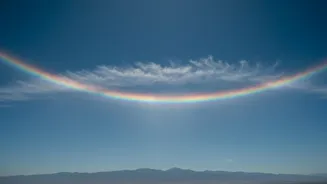
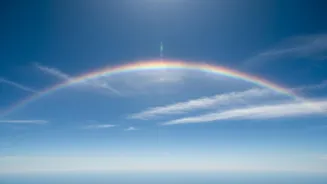
A circumhorizontal arc is always located below the sun and runs parallel to the horizon. This is a key difference from a traditional rainbow, which always appears in the part of the sky opposite the sun. It's also distinct from other ice halos like sundogs, which are bright spots that appear to the left and right of the sun, or the circumzenithal arc, which is an upside-down rainbow that appears high above the sun. Another phenomenon sometimes confused with it is cloud iridescence, which displays more random, pastel-like colours and can appear much closer to the sun. A true circumhorizontal arc has the distinct red-on-top colour order of a rainbow and is found far below the sun, about twice the distance of the common 22-degree halo.