







The Shadow of Rahu
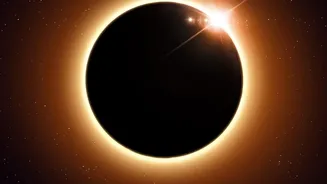
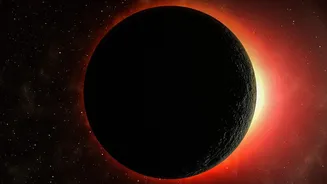
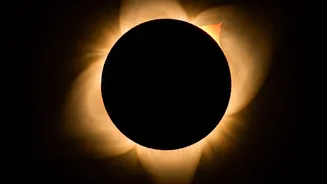
For many in India, a solar eclipse, or Surya Grahan, isn't just an astronomical event; it's a period steeped in mythology and considered inauspicious. The origin of this belief is famously tied to the Puranic legend of the Samudra Manthan, or the churning
of the cosmic ocean. In this story, the demon Svarbhanu disguised himself to steal a drink of Amrit, the nectar of immortality. The Sun (Surya) and Moon (Chandra) spotted the deception and alerted Lord Vishnu, who promptly beheaded the demon with his Sudarshana Chakra. But because the nectar had already touched his lips, the demon's head and body became immortal entities known as Rahu and Ketu. In eternal vengeance, Rahu is said to periodically swallow the sun, causing an eclipse. Since Rahu has no body, the sun always re-emerges, but the moments of its consumption are seen as a time of cosmic disturbance and negative energy.
A Time for Precaution
This mythological framework gives rise to a host of traditional practices aimed at warding off the perceived negative effects of the grahan. A central belief is that the atmosphere becomes impure, and harmful rays or energies are more prevalent. This leads to a common practice of fasting during the eclipse. Many believe that food cooked or consumed during this period can become contaminated or poisonous. Temple doors are often closed to protect their sanctity from these impure energies, and people are advised to take a cleansing bath both before and after the eclipse. Spiritual practices like chanting mantras, meditation, and prayer are highly encouraged, as their positive effects are believed to be magnified during this period.
Special Care for Pregnant Women
Perhaps the most persistent and widely followed customs relate to pregnant women. Tradition strongly advises expectant mothers to stay indoors during an eclipse to shield the unborn child from potential harm. It is a common belief, though one without scientific backing, that exposure could lead to birth defects. Pregnant women are also often told to avoid using sharp objects like knives or scissors, as it is thought this could result in the baby being born with a cleft lip or other marks. While health experts and scientists find no evidence for these claims, the practices are deeply embedded in cultural care and familial concern, and many follow them to ensure peace of mind.
The Scientific Viewpoint
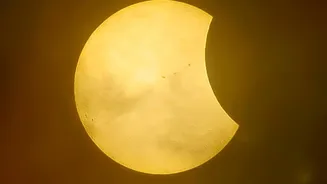
From a scientific perspective, an eclipse is a beautiful and natural alignment of celestial bodies. Astronomers and scientists consistently debunk claims of harmful rays (beyond the obvious danger to the eyes) or food becoming poisoned. NASA and other scientific bodies clarify that the only real danger associated with a solar eclipse is retinal damage from looking directly at the sun without proper protection, like certified eclipse glasses or a solar viewer. The idea that the sun emits unique, harmful radiation during an eclipse that can affect food or fetuses has been repeatedly refuted. The changes in light and temperature are natural consequences of the moon's shadow and pose no threat.
Navigating Two Worlds
For the modern Indian, an eclipse often represents a crossroads of belief. Many people who understand the science may still choose to observe certain traditions, whether out of respect for elders, a connection to their heritage, or simply as a 'better safe than sorry' approach. Science communicators work to dispel harmful superstitions, especially the fear that prevents people from witnessing a spectacular natural event safely. Yet, the rituals surrounding a grahan are not just about fear; they are also seen as a powerful time for spiritual reflection and inner work. This duality encapsulates a unique aspect of contemporary Indian life, where ancient stories and modern knowledge continue to coexist, often within the same household.