





What is Space Traffic Management?
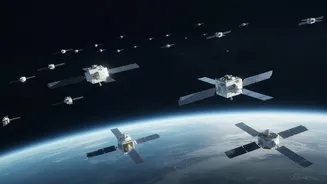
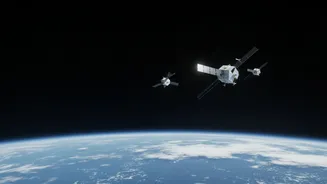
Think of it as air traffic control, but for space. Space Traffic Management involves the monitoring, coordination, and on-orbit synchronisation of activities to ensure the safety and sustainability of everything we send into orbit. With thousands of active
satellites, defunct spacecraft, spent rocket stages, and millions of smaller fragments zipping around the planet at hyper-velocities, the risk of collision is a serious and growing concern. A collision between two objects, or between a satellite and a piece of debris, can be catastrophic, potentially destroying valuable assets and creating thousands of new pieces of dangerous junk. The goal of space traffic management is to prevent this by tracking objects, predicting potential collisions, and creating a framework for safe operations.
A Crowded Sky and the Debris Problem
The orbital environment is becoming alarmingly congested. The problem is compounded by what is known as space debris—any human-made object in orbit that no longer serves a useful purpose. This includes everything from entire non-operational satellites to tiny paint flakes. Globally, there are over 34,000 pieces of debris larger than 10 cm being tracked, with millions of smaller, untraceable pieces. India itself has over 50 operational satellites and is responsible for 129 trackable pieces of space junk, including non-operational satellites and parts of launch vehicles. While this number is low compared to other major space powers, the focus of the International Conference on Spacecraft Mission Operations (SMOPS-2026) in Bengaluru underscores a proactive approach to prevent the problem from worsening. The conference brings together global space agencies and industry leaders to tackle challenges arising from large satellite constellations and increasing orbital congestion.
India's Proactive Strategy for Safer Orbits
India, through the Indian Space Research Organisation (ISRO), is not just participating in the conversation; it is actively building capabilities to manage it. The ISRO System for Safe & Sustainable Space Operations Management (IS4OM) is a dedicated facility established to ensure the safety of India's space assets. A key component of this strategy is Project NETRA (Network for space object Tracking and Analysis). This initiative provides India with an independent capacity to monitor space, track debris as small as 10 cm, and provide early warnings for potential collisions. This allows ISRO to perform Collision Avoidance Manoeuvres (CAM), where a satellite's path is slightly altered to dodge an incoming threat. Before NETRA, India was largely reliant on data from foreign entities.
Beyond Safety: Security and Economic Stakes
Effective space traffic management is not just about avoiding accidents; it is also a matter of national security and economic opportunity. An independent ability to monitor objects in orbit, known as Space Situational Awareness (SSA), is crucial for protecting the nation's vital space infrastructure, which includes communication, navigation, and remote sensing satellites. Having a clear picture of the space environment enhances military readiness and protects against potential threats. Furthermore, as the commercial space economy grows, robust traffic management becomes a prerequisite. It provides the stability and safety needed for private companies to operate large satellite constellations and for India to solidify its position as a globally trusted partner in space activities. The SMOPS-2026 conference also highlights the role of artificial intelligence and robotics in creating more efficient and autonomous mission operations for this new era.