





The ABCs of BIS Hallmarking
The Bureau of Indian Standards (BIS) hallmark is a certification that guarantees the purity of gold jewellery sold in India. Since June 2021, it has been mandatory for jewellers to sell hallmarked gold items. Think of it as an official seal of approval,
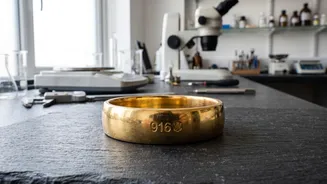
confirming that what you’re buying meets national standards. The modern hallmark consists of three key marks: the triangular BIS logo, the purity grade (like 22K916 for 22-carat gold), and a six-digit alphanumeric Hallmark Unique Identification (HUID) number. This HUID code is unique to each piece of jewellery, acting like a fingerprint. Consumers can instantly verify this code using the BIS Care app to check the jeweller's details, the hallmarking centre, and the purity of their specific item, adding a powerful layer of transparency and trust.
Enter Rhenium, the New Adulteration Threat
Recently, a major investigation by the newspaper Dainik Bhaskar brought a new concern to light: the use of rhenium to adulterate gold. Rhenium is a rare and very dense metal. Its density is remarkably close to that of gold, making it an ideal, and devious, way to increase the weight of gold jewellery without being easily detected. The investigation alleged that by mixing rhenium powder with gold, it is possible to create an ornament that feels just as heavy as pure gold but contains significantly less of the precious metal. An experiment conducted during the investigation showed an ornament with only about 81.7% gold (around 20-carat purity) was able to pass multiple tests and even receive a 22-carat (91.6% purity) hallmark certification.
Why Standard Tests Can Fail
The core of the problem lies in the limitations of common testing methods. Many jewellers use X-Ray Fluorescence (XRF) machines, or 'karatmeters', to check purity. These machines analyse the surface of the metal to determine its composition. However, some XRF machines, especially older or improperly calibrated ones, may not be equipped to detect specific elements like rhenium. The energy signatures of rhenium and gold can be close enough that a lower-resolution machine might misread the adulterated mix as pure gold. The investigation suggested that the adulterant powder could be sourced from China, with agents claiming it can be mixed up to 25% without being caught by conventional methods. More rigorous and definitive tests, like a fire assay (which is destructive) or advanced spectroscopy, can reliably detect such metals, but these are not used for routine checks at a jewellery counter.
Is This a Widespread Problem?
The use of dense metals to cheat buyers is not an entirely new concern. Traders have previously raised alarms about other metals like iridium, osmium, and ruthenium being used to inflate gold weight. However, the recent investigation highlighting rhenium's ability to bypass even hallmarking centre checks has created fresh anxiety. It raises serious questions about the consistency of surveillance and the technological capabilities of some testing centres. A draft audit report from the Comptroller and Auditor General (CAG) has also flagged that the BIS missed a significant portion of its surveillance targets for hallmarking centres, citing staff shortages. While these reports don't prove widespread fraud, they expose potential vulnerabilities in the system that protects consumers.
How Can You Protect Your Purchase?
While these developments are concerning, the BIS hallmark with HUID remains the single most important tool for a consumer. The system creates a traceable record for each piece of jewellery, linking it back to the jeweller and the assaying centre. For buyers, this means vigilance is key. First, always insist on hallmarked jewellery and verify the HUID code on the BIS Care app before you pay. Second, always buy from reputable and trusted jewellers who have a long-standing history. Third, demand a proper, itemised bill for your purchase, as this is your legal proof of the transaction and the purity promised. If a deal seems too good to be true, with making charges far below the industry standard or gold rates lower than the market price, it warrants extra caution.