







The Pink City: Jaipur, India
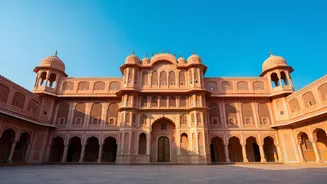
Founded in 1727 by Sawai Jai Singh II, the walled city of Jaipur in Rajasthan is a stunning example of early urban planning. Unlike many cities in the region that grew organically on hilly terrain, Jaipur was laid out on a plain according to a precise
grid plan inspired by Vedic architecture. The city is famously known as the 'Pink City' because its buildings were painted a terracotta pink in 1876 to welcome the Prince of Wales, a colour that symbolised hospitality. This tradition has been maintained, giving the city a uniquely warm and uniform appearance. Its streets feature continuous colonnaded markets that intersect at large public squares called 'chaupars', and the entire layout was designed to be a thriving commercial capital—a role it still embraces today with its vibrant artisan and cooperative traditions.
An Architectural Marvel: Venice, Italy
There is no city on Earth quite like Venice. Founded in the 5th century on a collection of 118 small islands in a shallow lagoon, it evolved into a major maritime power by the 10th century. The entire city is an extraordinary architectural masterpiece, where canals serve as streets and even the smallest buildings house priceless works of art by masters like Titian and Tintoretto. Inscribed as a UNESCO site in 1987, Venice is celebrated not just for its incomparable art and architecture but as a testament to humanity's ability to master a challenging environment. The dynamic relationship between the city and its lagoon created a unique urban system, where the network of canals and small 'rii' became the very arteries of a city built on water. Despite facing threats from climate change and mass tourism, it remains a symbol of human ingenuity and beauty.
The Fairy Chimneys: Cappadocia, Turkey
The landscape of Cappadocia in central Turkey looks like it was plucked from a fairy tale. Millions of years ago, volcanic eruptions blanketed the region in soft volcanic ash, or tuff. Over millennia, wind and water eroded this soft rock, but harder basalt caps protected the pillars directly beneath them, creating bizarre and beautiful cone-like formations known as 'fairy chimneys'. But what makes this landscape truly remarkable is how humans adapted to it. As early as the 4th century, people began carving dwellings, monasteries, and entire underground cities directly into the rock. The Göreme National Park, a UNESCO site since 1985, is filled with these rock-hewn sanctuaries, many containing vibrant frescoes that provide a unique glimpse into Byzantine art. This fusion of natural wonder and human history creates a landscape that is both surreal and deeply spiritual.
Emerald Waters and Limestone Towers: Ha Long Bay, Vietnam
Ha Long Bay, located in the Gulf of Tonkin, is a spectacular seascape renowned for its thousands of limestone karsts and islets that rise dramatically from the emerald water. Its name translates to 'Descending Dragon', a reference to a local legend where dragons created the islands to protect Vietnam from invaders. Recognised by UNESCO first in 1994 for its aesthetic value and again in 2000 for its geological significance, the bay is a mature karst landscape that has taken 20 million years to evolve. The area includes over 1,600 islands and islets, creating a majestic natural spectacle of towering stone pillars. This incredible diversity in landforms has also created a rich ecosystem, home to many endemic plant and animal species. Exploring the bay by boat reveals hidden caves, grottoes, and quiet lagoons, showcasing a world where water and stone have been in a creative dialogue for eons.
The Lost City of the Incas: Machu Picchu, Peru
Perched high in the Andes Mountains on a narrow saddle between two peaks, Machu Picchu is the most amazing urban creation of the Inca Empire at its height. Built in the 15th century, likely as a royal estate for the emperor Pachacuti, the site's exact purpose remains a topic of debate. What is certain is the genius of its construction. The Incas used a technique of cutting stones so precisely that they fit together without mortar, allowing the structures to withstand centuries of earthquakes. The site is divided into an agricultural sector, with its iconic terraces that prevent erosion, and an urban sector with temples, residences, and plazas. Abandoned in the 16th century and hidden from the wider world for centuries, it was designated a UNESCO World Heritage site in 1983 for both its cultural and natural significance, celebrating not only the Inca architecture but also its seamless integration into the dramatic mountain landscape.