






What is Frontier AI?
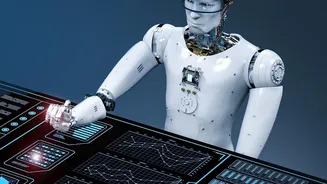
Before diving into the mathematical discoveries, it's important to understand what a 'frontier AI' is. This term refers to the most advanced and powerful AI models currently in existence. Unlike older AI systems designed for narrow tasks, frontier models are
large, general-purpose systems that exhibit emergent abilities—capabilities that weren't explicitly programmed but arise from their immense scale and complex training. Think of them as the cutting edge of AI, able to perform complex reasoning, generate code, and analyze data across a wide variety of domains. They represent a shift from AI as a simple tool to AI as a system that can plan, execute, and complete multiple steps with less human intervention.
How Did an AI Discover New Maths?
OpenAI’s announcement details work from a powerful, unreleased internal model. This AI was not just solving textbook problems; it was tasked with tackling unsolved problems at the forefront of mathematics. The company revealed that the AI generated these results after being fed around 4,000 open problems. For each problem, the model attempted to generate a proof, a logical step-by-step argument that establishes the truth of a mathematical statement. The process was highly efficient, with each result taking, on average, just three hours of computing time. The discoveries span a wide range of fields, including algebra, number theory, and theoretical computer science. By analyzing vast patterns in existing mathematical literature, the AI can spot connections and propose pathways that might not be obvious to human researchers.
Are the Results Actually New and Correct?
This is the most critical question, and the answer is complex. The headline's use of 'potentially' is key. OpenAI released its findings—over 700 manuscripts in total—on the code-hosting platform GitHub, not in a traditional peer-reviewed journal. This means the global mathematics community is now tasked with the massive job of verifying each proof. While many of the proofs were checked using a computer language called Lean, designed to verify logical correctness, human understanding remains the ultimate standard. The process has sparked debate, with some experts expressing concern that AI labs are moving faster than the academic world can validate, potentially creating a two-tiered system where proprietary models outpace public research. This release is therefore not the end of a discovery, but the beginning of a long verification process.
A New Era of Human-AI Collaboration
The announcement is less about AI replacing mathematicians and more about creating an incredibly powerful collaborator. Researchers note that AI can accelerate discovery by handling tedious tasks, searching through vast amounts of literature, and generating novel conjectures for humans to investigate. This partnership could democratize research, allowing more people to tackle high-level problems. However, this event also highlights a growing tension. Mathematicians and academic bodies are calling for more transparency and equitable access to these powerful frontier models. In response, OpenAI has started working with an independent advisory group of mathematicians to establish best practices for releasing AI-generated science. The goal is to ensure that as AI accelerates discovery, it remains a tool that enhances human understanding, rather than replacing it.