



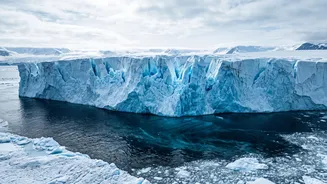
The 'Doomsday Glacier' Explained
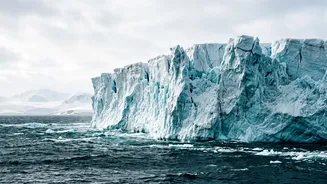
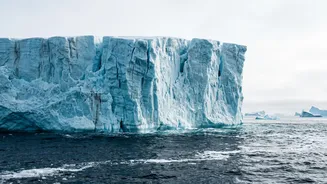
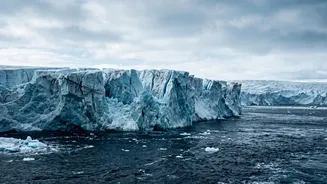
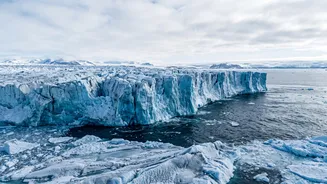
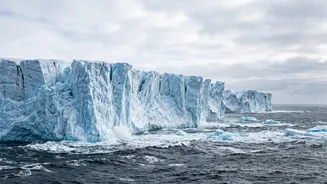
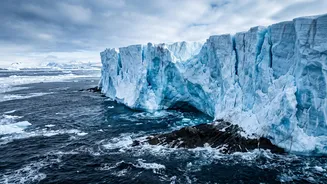
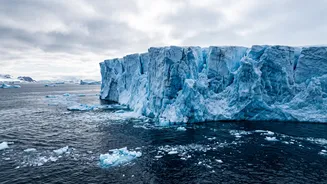
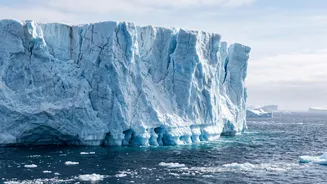
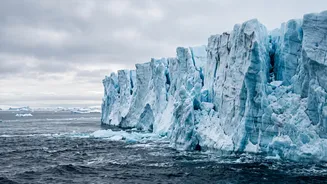
The Thwaites Glacier is one of the largest and fastest-melting glaciers in the world, covering an area roughly the size of Great Britain or the US state of Florida. It currently contributes to about 4% of annual global sea-level rise. Its ominous nickname
comes from its critical role as a natural dam. It holds back the rest of the colossal West Antarctic Ice Sheet, which, if it were to collapse entirely, could raise global sea levels by over three metres. The complete collapse of Thwaites alone would result in a sea-level rise of about 65 centimetres, or over two feet. For decades, scientists have watched it retreat at an alarming pace, losing over a trillion tons of ice since the year 2000. The primary suspect has always been warming ocean waters, and recent research is providing a much clearer, and more worrying, picture of the attack.
A Hidden Assault From the Sea
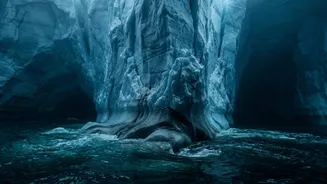
The most groundbreaking findings come from studying a critical area known as the 'grounding line'—the point where the glacier lifts off the seabed and begins to float. Previously, models treated this as a relatively fixed line. However, new data from satellite observations and underwater robots reveals it is more like a wide 'grounding zone', where the tides create a powerful pumping action. This 'tidal pumping' flushes warm, salty ocean water deep underneath the grounded portion of the ice, sometimes for several kilometres inland. This allows the warmer deep ocean water to bypass the colder, insulating layers and cause vigorous melting right where the glacier is most vulnerable.
The Alarming New Projections
A recent study published in Nature Communications integrated this new understanding of the grounding zone into ice-sheet models. The results are stark. The new model suggests that Thwaites' contribution to sea-level rise by the year 2100 could be up to 30 millimetres, approximately double what previous projections had estimated, even without any further increase in climate warming. This accelerated melting is weakening the glacier's connection to an underwater ridge that currently helps to hold it back. Scientists now estimate there is a 60% chance the glacier will detach from this stabilising ridge before 2100, which would significantly speed up its flow into the ocean.
An Unavoidable Future?
The situation is so serious that some changes are now considered unavoidable. Research from the British Antarctic Survey found that even in a hypothetical scenario where all ocean-driven melting stopped instantly, Thwaites would continue to lose ice for at least the next 150 years due to the instability that has already been triggered. This is because the glacier rests on a retrograde slope, meaning the bedrock underneath it deepens further inland. As it melts and retreats, more of its base is exposed to the warm water, creating a feedback loop of accelerating ice loss. While the damage can't be completely undone, scientists stress that reducing greenhouse gas emissions to slow ocean warming is still crucial to prevent the worst-case scenarios and slow the rate of retreat.
What This Means for India's Coastline
While Antarctica may seem a world away, the fate of Thwaites has direct implications for India. A sea-level rise of 65 centimetres from Thwaites' collapse, let alone the potential for metres more from the rest of the West Antarctic Ice Sheet, would be catastrophic for India's 7,500-kilometre coastline. Major metropolitan areas like Mumbai, Chennai, Kolkata, and Surat, which are home to tens of millions of people and critical economic infrastructure, are exceptionally vulnerable to rising sea levels. Increased coastal flooding, shoreline erosion, and the intrusion of saltwater into freshwater sources would become devastatingly common. The accelerated melting of the 'Doomsday Glacier' is not a remote scientific curiosity; it is a direct and growing threat to the safety and prosperity of India's coastal communities.