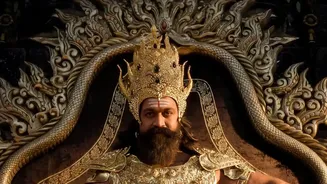








In the grand tapestry of the Ramayana, few figures are as complex as Ravana. While known as the demon king of Lanka, his name wasn't always so. The story of how he got it is a dramatic tale of arrogance, power, and an earth-shaking cry.
The King Born as Dashagriva
Before he was the
formidable antagonist of Rama, the king of Lanka was known by a different name: Dashagriva or Dashanana. Born to the sage Vishrava and the Rakshasa princess Kaikasi, his birth name literally meant 'the one with ten heads'. These ten heads are often said to symbolize his profound knowledge of the four Vedas and six Shastras, making him one of the most learned scholars of his era. He was a figure of immense power, a capable ruler, and a master of statecraft, who through intense penance to the creator god Brahma, was granted boons that made him nearly invincible. However, his vast intellect and power were matched only by his growing pride, an arrogance that would ultimately lead to him earning the name that would define his legacy.
An Arrogant Challenge at Mount Kailash
The pivotal moment in Dashagriva's life occurred during a journey in his flying chariot, the Pushpaka Vimana, which he had usurped from his half-brother, Kubera. As he approached Mount Kailash, the sacred abode of Lord Shiva, his chariot came to an abrupt halt, unable to fly over the peak. There, he was met by Shiva's devoted attendant, Nandi, who informed him that no one was allowed to pass as Shiva and his consort Parvati were in repose. Mocking Nandi's appearance, the arrogant Dashagriva questioned the very authority of Shiva and, in a display of supreme hubris, decided to uproot the entire mountain and move it out of his way. He placed his twenty powerful arms beneath the mountain and began to lift, causing Kailash to tremble.
The Cry That Named a King
As the mountain shook, a terrified Parvati turned to Shiva. The omniscient god, aware of Dashagriva's audacious act, calmly pressed down on the mountain with his big toe. The immense weight immediately trapped Dashagriva's arms beneath it, crushing them. The pain was unbearable, and the mighty king let out a terrifying, earth-shattering scream. This thunderous cry, or 'rava' in Sanskrit, was so loud that it was said to have shaken all three worlds. It is from this momentous roar of agony that he earned his new name. Impressed by both the sheer power of his cry and his subsequent devotion, Shiva named him 'Ravana', which means 'one who roars' or 'one who screams loudly'.
From Pain to Penance
Trapped and humbled, Ravana's arrogance gave way to devotion. Advised by his ministers, he spent a thousand years pinned beneath the mountain, singing hymns in praise of Lord Shiva. It is during this period that he is said to have composed the famous 'Shiva Tandava Stotram', a powerful hymn that describes Shiva's cosmic dance. In some tellings, he fashioned a musical instrument from one of his heads and his own tendons to create his devotional song. Pleased by this profound act of penance and worship, Shiva finally forgave and released Ravana. Not only did he free him, but he also gifted him the invincible celestial sword, Chandrahasa, further solidifying Ravana's might, but now as a great devotee of Shiva.
A Name That Holds a Legacy
The name Ravana, therefore, is more than just a label; it is a story in itself. It perfectly encapsulates the duality of his character—a being of immense power and intellect brought to his knees by hubris, only to rise again through devotion. While he is primarily remembered as the villain who abducted Sita, leading to the epic conflict of the Ramayana, the origin of his name reveals a more complex figure. It reminds us that he was not just a demon king, but also a scholar, a musician, and a fervent devotee whose defining moment came not from a conquest, but from a cry of pain that transformed into a song of worship.