

Our Twin's Missing Companion
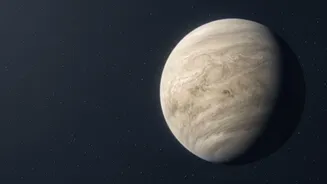
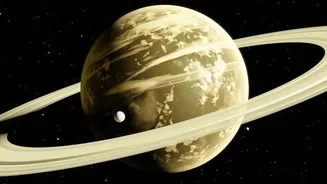
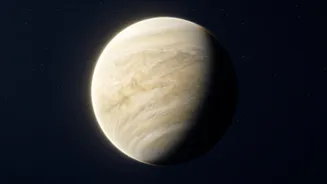
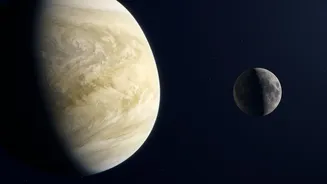
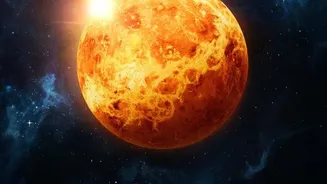
In our solar system, Venus stands out. It’s similar to Earth in size, mass, and structure, earning it the nickname of our planetary twin. Yet, while Earth enjoys the steady presence of its Moon, Venus travels the cosmos alone. For decades, scientists
have puzzled over this. Previous theories suggested a massive external impact might have destroyed a hypothetical Venusian moon, or perhaps the planet never experienced the right kind of collision to form one in the first place. A new study, however, proposes a more intimate and inevitable tragedy: Venus itself may be the culprit in its moon's disappearance.
The Inward Spiral
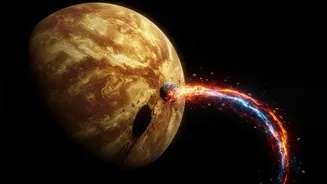
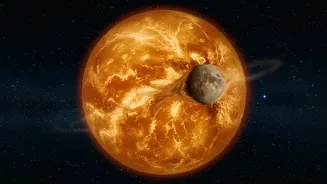
New research led by astrophysicist Stephen Kane of the University of California, Riverside, suggests that no external catastrophe was needed. Instead, the planet's own physical properties doomed its satellite. The key lies in its rotation. Earth spins relatively quickly, completing a rotation in 24 hours. This transfers rotational energy to our Moon, causing it to slowly drift farther away from us by about four centimeters every year. Venus is the complete opposite. A single day on Venus lasts a staggering 243 Earth days. According to computer simulations, this incredibly slow spin would reverse the tidal effect. Instead of pushing a moon away, Venus’s gravity and sluggish rotation would have pulled its moon into a decaying orbit, causing it to spiral inward toward the planet.
A Cosmic Crash Foretold in Code
To test this hypothesis, Kane's team ran extensive computer simulations. They first modeled the Earth-Moon system to ensure their physics was sound, accurately reproducing its current evolution. Then, they turned their attention to Venus, running scenarios with various hypothetical moons and different planetary rotation speeds. The results were shockingly consistent. In most simulations, regardless of the moon’s size, the outcome was a collision. The models showed that more massive moons would have crashed even faster. This suggests that if Venus ever formed a moon, its destruction wasn't a matter of if, but when. According to the models, this cosmic impact could have happened anywhere from 30 million to 1.7 billion years after the moon formed.
Searching for a Ghostly Past
The study provides a compelling theory but doesn't definitively prove Venus had a moon. Finding direct evidence of such an ancient collision is incredibly difficult. Around a billion years ago, massive volcanic activity led to a major resurfacing event on Venus, effectively paving over about 80% of its surface and erasing much of its older geological history. Any crater from a moon impact would be long gone. However, clues might still be hidden deep beneath the surface. On Earth, seismic studies have detected strange structures in the mantle that could be remnants from the giant impact that created our own Moon. Future seismic missions to Venus could potentially uncover similar evidence of a swallowed satellite, finally confirming this theory of a lost world.
What This Means for Other Worlds
This research reshapes our understanding of planetary systems. It suggests that simply being able to form a moon isn't enough; a planet also needs the right conditions to keep it. Slowly rotating planets, which astronomers may find orbiting other stars, might be prone to losing their moons in this dramatic fashion. The presence of a large moon is thought to play a role in stabilizing a planet's axis and climate, which can be crucial for habitability. While scientists are not sure if a moon is essential for life, losing one in a cataclysmic impact would certainly change a planet's evolutionary course. This new understanding of Venus's past offers a cautionary tale for what might be a common phase in the life of rocky planets across the galaxy.