




The Challenge of Power in Deep Space
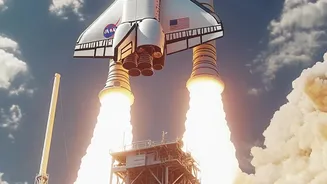
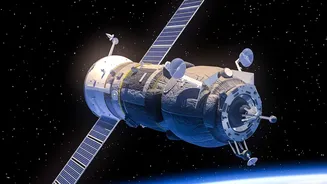
For decades, space exploration has relied heavily on two main power sources: chemical propellants for launch and solar panels for electricity in orbit. While effective, solar power has significant limitations for long-duration missions on other worlds.
Its effectiveness drops dramatically the farther a spacecraft travels from the sun. On the Moon, a single night lasts for two Earth weeks, plunging everything into darkness and extreme cold. On Mars, planet-encircling dust storms can block the sun for extended periods, rendering solar arrays useless. For astronauts to live and work sustainably in these environments, they need a power source that is continuous, reliable, and powerful, regardless of sunlight.
A Nuclear-Powered Future
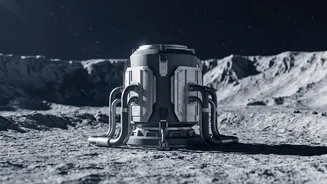
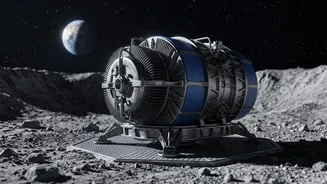
The solution, according to NASA and the Department of Energy (DOE), is nuclear fission. This isn't about nuclear propulsion in the way science fiction often portrays it, but about creating small, durable nuclear reactors. These 'fission surface power' systems work by splitting atoms to generate a steady supply of heat, which is then converted into electricity. One key project, the Fission Surface Power (FSP) initiative, aims to build a 40-kilowatt class power system—enough to run about 30 households continuously for ten years. This kind of compact, long-lasting energy source would be a game-changer, enabling everything from life support in habitats to powering rovers and scientific experiments around the clock.
Two Agencies, One Cosmic Goal
This collaboration is not entirely new; the two agencies have worked together since the dawn of the space age on nuclear applications, from the SNAP-10A reactor flown in 1965 to the radioisotope power systems that still power the Voyager probes today. However, a recently signed Memorandum of Understanding titled 'Accelerating American Leadership in Space Nuclear Power and Propulsion' marks a significant escalation of this partnership. The agreement formalizes an end-to-end collaboration, uniting the DOE's expertise in nuclear reactor design and fuel production with NASA's experience in mission integration and space operations. This unified approach is designed to streamline development and ensure the highest safety standards are met from the lab to the launchpad.
Enabling the Artemis Generation
The immediate goal is to support NASA's Artemis program, which aims to establish a sustainable human presence on the Moon. A launch-ready lunar surface reactor is targeted for development by 2030. This reactor, dubbed Lunar Reactor-1 (LR-1), would provide the foundational power needed for a permanent lunar outpost. It would energize habitats, communication systems, and in-situ resource utilization (ISRU) plants, which could, for example, extract water ice from lunar craters. The power systems demonstrated on the Moon will serve as a crucial proving ground for the even more demanding energy needs of future human missions to Mars. The technology is designed to be extensible, meaning the lessons learned and systems developed for the Moon can be adapted for the Red Planet.
From Science Fiction to Reality
The vision extends beyond just keeping the lights on. The partnership is also advancing nuclear thermal propulsion, which involves using a reactor to heat a propellant like hydrogen, creating far more efficient thrust than traditional chemical rockets. This could dramatically shorten transit times for missions to Mars, reducing astronauts' exposure to deep-space radiation and cutting a nine-month journey down by 25% or more. Another mission, Space Reactor-1 Freedom (SR-1), is planned to launch by 2028 to demonstrate nuclear propulsion in deep space. By investing in both surface power and advanced propulsion, NASA and the DOE are laying the essential groundwork for humanity's next giant leap, transforming what was once the realm of science fiction into a tangible engineering objective.