






What is a Holding Pattern?
When a plane delays its landing by circling, it is often entering what pilots and air traffic controllers call a 'holding pattern'. This isn't just aimless circling; it's a highly precise, predetermined flight path, often shaped like a racetrack. These
patterns are flown over a specific navigational point, known as a 'fix', which can be miles away from the airport itself. Flight crews use sophisticated navigation systems to fly this pattern exactly as instructed, ensuring they remain in a protected, designated block of airspace while they wait. Think of it as a waiting room in the sky, a crucial tool for managing the flow of air traffic safely and efficiently.
A Traffic Jam in the Sky
One of the most frequent reasons for a holding pattern is simple air traffic congestion. Major airports, especially during peak hours, are incredibly busy. Air Traffic Control (ATC) must maintain safe distances between all landing and departing aircraft. If a runway gets temporarily backed up, or if there's a higher-than-expected volume of arrivals, ATC will use holding patterns as a buffer. This allows controllers to sequence planes in an orderly fashion, preventing the airspace around the airport from becoming overcrowded and ensuring each plane has a clear slot to land.
Waiting on the Weather
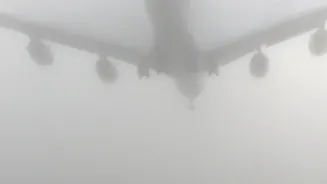
Weather is another major factor that can force a delay in landing. While the sky might look clear from your window, conditions at the airport on the ground could be unsafe for landing. This can include sudden fog that reduces visibility, strong crosswinds that make a stable approach difficult, or a fast-moving thunderstorm cell directly over the airfield. In these situations, holding patterns allow aircraft to wait at a safe distance and altitude until the weather improves and pilots can be assured of a safe and smooth landing.
Keeping the Runway Clear
A runway must be completely clear before a plane is given permission to land. Sometimes, a delay occurs because the runway is temporarily unavailable. This could be due to a number of reasons: an aircraft that has just landed might be slow to exit the runway, an inspection vehicle could be performing a check for debris, or in rare cases, an animal might have wandered onto the tarmac. If ATC cannot confirm the runway is clear, they will instruct an approaching aircraft to perform a 'go-around' — a standard procedure where the plane aborts its landing, climbs back to a safe altitude, and circles around for another attempt.
A Sign of Safety, Not Danger
Another reason for a go-around or a hold is an 'unstabilized approach'. This means the aircraft isn't perfectly aligned with the runway, or it might be too high, too low, or too fast as it nears the touchdown point. Rather than force an unsafe landing, pilots are trained to initiate a go-around as a proactive safety measure. Similarly, if a minor sensor issue is detected, pilots might use the time in a holding pattern to run through checklists or coordinate with maintenance on the ground before proceeding. These actions demonstrate an abundance of caution and are hallmarks of a well-functioning and safety-first aviation system.