









A Partnership to Decode the Mind
In a significant push at the intersection of artificial intelligence and neuroscience, Meta has partnered with the Basque Center on Cognition, Brain and Language (BCBL), a renowned research institute in Spain. Their joint project, dubbed Brain2Qwerty,
aims to do something extraordinary: translate brain activity into text without requiring surgical implants. This collaboration brings together Meta's formidable AI prowess with BCBL's deep expertise in the brain's language centers, focusing on developing assistive technologies for people who have lost the ability to communicate due to brain injuries or neurological diseases. By making their models and datasets open source, they are not just advancing their own work but are also fueling a broader scientific pursuit to understand the human brain.
The Magic of Magnetoencephalography (MEG)
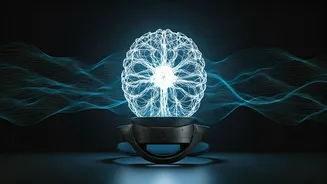
The key to this research is a non-invasive technology called magnetoencephalography, or MEG. Unlike invasive methods that involve surgically placing electrodes on the brain, MEG uses a helmet-like device to measure the tiny magnetic fields generated by the brain's electrical activity. It provides a high-resolution, millisecond-by-millisecond snapshot of brain function. In the Brain2Qwerty project, volunteers wore an MEG device while typing out thousands of sentences. This massive dataset of brain activity paired with the corresponding text was then used to train a powerful AI model. The AI learns to recognize the specific neural patterns associated with the intention to type certain characters, words, and sentences.
From Brainwaves to Coherent Sentences
The latest version of the system, Brain2Qwerty v2, represents a major leap forward. The AI no longer just guesses at individual characters; it now decodes entire words and sentences. It achieves this by using a sophisticated, multi-layered deep learning architecture. First, the model processes the raw, noisy MEG signals to identify patterns related to motor commands for typing. Then, a fine-tuned large language model (LLM)—similar to the technology behind modern chatbots—steps in. This LLM uses its understanding of language, grammar, and context to refine the initial predictions, correcting errors and assembling the most probable sentence the user intended to write. This combination of signal processing and semantic understanding is what makes the system so powerful.
A Leap in Accuracy
The results from the latest research are impressive. The Brain2Qwerty v2 system achieved an average word accuracy of 61%, with the top-performing participant reaching 78%. This means for the best user, more than half of all sentences were decoded with one word error or less. To put this in perspective, previous non-invasive methods hovered around an 8% accuracy rate. This dramatic improvement suggests that with more data, the performance gap between non-invasive and surgical brain-computer interfaces (BCIs) could narrow significantly. Meta's researchers found that decoding accuracy improves predictably with more training data, pointing a clear path toward even better results.
The Road Ahead and Its Hurdles
Despite the exciting progress, the technology is still far from being a consumer product. The current MEG hardware is bulky, expensive, and must be used in a magnetically shielded lab environment, making it impractical for everyday use. Furthermore, the system was trained on healthy volunteers who were actively typing. Applying this technology to help patients who are unable to move will require new research and training approaches. The ultimate goal is to create a system that can decode intended speech or text directly from thought, without any physical movement involved, but this remains a monumental challenge.
Navigating the Ethical Maze
As with any technology that touches the human mind, this research opens up a complex ethical landscape. The ability to decode brain activity raises profound questions about mental privacy, data security, and personal autonomy. If a machine can read our intended words, what's to stop it from accessing deeper thoughts or being used for manipulation? Establishing a robust ethical framework is paramount. This includes ensuring user consent is paramount, protecting sensitive neural data from being misused, and guaranteeing that individuals maintain full control over the technology. The conversation about these safeguards must happen now, long before such devices become widespread.