






India's Leap into Human Spaceflight
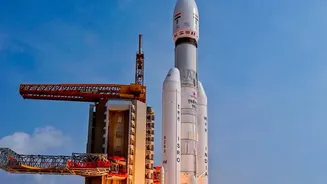
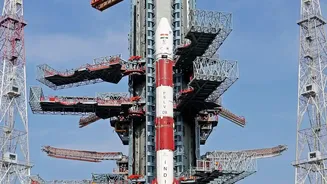
The Gaganyaan programme represents a monumental step for the Indian Space Research Organisation (ISRO) and the nation. The primary objective is to demonstrate the capability to launch a crew of up to three astronauts into a low-Earth orbit of 400 kilometres
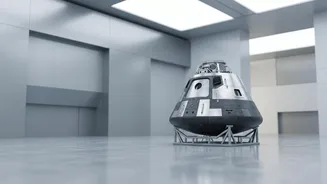
and bring them back safely to Earth with a splashdown in the ocean. This achievement would place India in an elite group of nations with independent human spaceflight capabilities, alongside the US, Russia, and China. The entire mission, from the powerful Human Rated Launch Vehicle (HRLV) to the sophisticated life support systems, is a testament to India's growing prowess in space technology. However, before any astronaut boards the capsule, ISRO must be certain that the vehicle they call home is the safest ever built by the agency.
The Philosophy of Qualification Testing
In aerospace engineering, particularly for human-rated missions, a single successful trial is not enough. The process is governed by 'qualification testing,' where components and systems are deliberately subjected to forces and conditions far more extreme than they are ever expected to face during an actual mission. If a system survives these punishing ground tests, it earns its right to fly. This rigorous approach is central to the Gaganyaan mission. ISRO is conducting a battery of tests to validate every scenario, from a nominal flight to a catastrophic failure on the launchpad. This multi-test push ensures that safety is not just a feature, but the fundamental design principle of the crew module, building layers of confidence through repeated, successful demonstrations under duress.
Scenario One: The Pad Abort Test
One of the most dangerous moments of any space mission is on the launchpad itself. A Pad Abort Test (PAT) is designed to simulate a worst-case scenario: an imminent failure of the rocket before it even lifts off. In such an event, the Crew Escape System (CES)—a set of powerful, quick-acting solid-fuel motors—must fire instantly to pull the crew module away from the failing launch vehicle. This test, which ISRO successfully conducted, subjects the crew module to incredible acceleration and g-forces. The structure must withstand being violently yanked away from the rocket stack, demonstrating its integrity under explosive force and proving it can protect the crew from the very first second of the mission.
Scenario Two: The In-Flight Abort Test
What if an emergency occurs moments after launch, as the rocket is hurtling through the atmosphere? This is the purpose of the In-Flight Abort Test. These tests are conducted at high altitudes, often during the 'transonic' phase when the vehicle is breaking the sound barrier and aerodynamic stresses are at their peak. A successful test, like the Test Vehicle Abort Mission-1 (TV-D1), demonstrates that the Crew Escape System can separate the module from the booster even under maximum aerodynamic load. The module's structure must endure the intense forces of the escape motors firing while being pushed by fast-moving air, proving it can remain stable and protect the astronauts during a high-speed, high-altitude emergency.
Scenario Three: The Integrated Air Drop Test
Whether the mission is a complete success or ends in an abort, the final step is a safe return to Earth. The Integrated Air Drop Tests (IADT) are designed to validate this crucial final phase. In these tests, a full-scale model of the crew module is lifted by a helicopter or aircraft to a high altitude and dropped. This simulates the module's return from space, testing the entire parachute deployment sequence—from the smaller drogue chutes that provide initial stabilization to the massive main parachutes that slow the capsule for a gentle splashdown. Recent IADT successes have validated the parachute system's complex sequencing and, critically, confirmed the module's structural ability to withstand the shock of parachute deployment and the final impact with the water.
Building Confidence, One Test at a Time
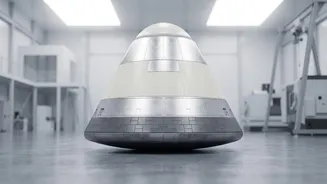
Beyond the major abort and landing tests, ISRO has also recently qualified other critical structural systems. These include a test to validate the strength of the module when the Apex Cover—which protects the parachutes—is jettisoned. Another successful test confirmed the clean separation of the umbilical cord that connects the crew module to the service module. Finally, ISRO has qualified the Crew Module Up-righting System (CMUS), an inflation system that ensures the capsule flips to the correct orientation after splashing down in the sea, which is a vital crew safety requirement. Each of these tests confirms that every joint, panel, and mechanism can handle the specific, violent forces they will encounter, ensuring the capsule remains a safe haven from launch to landing.