




The Four-Hour Promise
The core promise is a travel time of approximately 3 hours and 50 minutes between Delhi and Varanasi. This is not an upgrade to the existing railway lines but an entirely new, dedicated high-speed rail corridor designed for 'bullet trains' capable of hitting
operational speeds of 320 km/h. Currently, the fastest train on this route is the Vande Bharat Express, which takes about eight hours to cover the distance. Other express trains can take anywhere from 11 to 17 hours. The new corridor, managed by the National High Speed Rail Corporation Limited (NHSRCL), represents a monumental leap in passenger rail technology for the country.
How Is This Speed Possible?
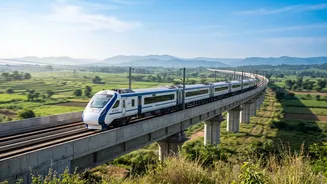
Achieving such high speeds requires specialised infrastructure. The Delhi-Varanasi corridor will be built on a dedicated, grade-separated track, meaning there will be no level crossings for people or vehicles. The alignment will be largely elevated on viaducts with some underground sections, particularly in dense urban areas, to ensure the track is as straight as possible—a necessity for trains running at 350 km/h. The project will use Japanese Shinkansen technology, similar to the system being implemented for India's first bullet train project, the Mumbai-Ahmedabad corridor. This involves advanced signalling systems and specially designed rolling stock built for speed, safety, and comfort.
The Route And Its Stations
The planned route is approximately 865 kilometres long and is set to transform connectivity across Uttar Pradesh. The corridor will link several key economic, cultural, and religious hubs. There are 12 stations proposed for the main line: Sarai Kale Khan in Delhi, Noida, Jewar International Airport, Mathura, Agra, New Etawah, South Kannauj, Lucknow, Raebareli, Prayagraj, New Bhadohi, and Varanasi. Crucially, the plan also includes a 123-km spur line to connect Ayodhya with Lucknow, further boosting religious tourism. The inclusion of a station at Jewar Airport will create a powerful multimodal transport hub, connecting air travel with high-speed rail.
Project Status and Timeline
It is important to understand that this project is still in its planning and pre-construction phase. While the four-hour journey is the goal, it is not happening tomorrow. The Detailed Project Report (DPR) has been submitted, and extensive surveys like aerial LiDAR mapping have been completed to finalise the alignment. In the Union Budget for 2026-27, the Delhi-Varanasi corridor was announced as one of seven new high-speed rail projects to be developed. While land acquisition and construction are yet to begin in earnest, the project is considered a high priority. Indicative timelines suggest the corridor could become operational around 2031, though this is subject to land acquisition, funding, and construction progress.
The Broader Impact
The implications of this corridor extend far beyond just a faster train ride. Economically, such large-scale infrastructure projects are expected to create thousands of jobs during construction and spur development in the cities along the route. By connecting major industrial and tourist centres like Agra, Lucknow, and Prayagraj so efficiently, the corridor could significantly boost business travel and tourism. Environmentally, high-speed electric trains offer a cleaner alternative to short-haul flights and road transport, potentially reducing carbon emissions and traffic congestion. It also promises to release capacity on the existing, over-strained railway network, which could improve the speed and reliability of conventional passenger and freight services.