








The High-Stakes Hunt Below the Seabed
India's economy runs on imported energy. Nearly 90% of the crude oil and about half of the natural gas consumed in the country come from abroad, exposing the economy to volatile global prices and geopolitical risks. To counter this, the government is pushing
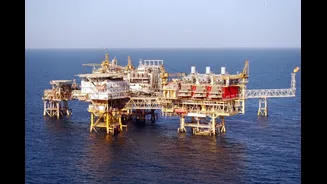
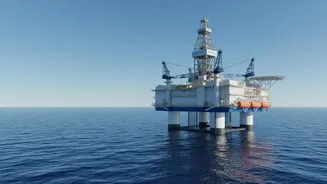
for a massive increase in domestic production, with deepwater basins like the Krishna-Godavari, Mahanadi, and Andaman representing the next great frontier. However, exploring these depths is one of the riskiest and most expensive ventures in the energy industry. A single exploratory well can cost upwards of ₹1,000 crore, with a high probability of finding nothing commercially viable. This immense financial risk has historically deterred private and foreign investment, leaving much of India's vast exclusive economic zone largely unexplored.
Drilling in the Dark: The Data Deficit
The core challenge in India's deepwater sector is not a lack of potential reserves but a severe lack of high-quality geological data. Before drilling, companies use 3D seismic surveys to create a computer-generated map of the subsurface. But these maps are just an interpretation. The only way to confirm what truly lies kilometres beneath the seabed—the rock types, pressure, temperature, and presence of hydrocarbons—is to drill an exploratory well. Without a dense network of existing wells to provide this 'ground truth', every new well in a frontier area is a high-risk gamble. This data scarcity makes it incredibly difficult to accurately assess prospects, leading to a high failure rate for wildcat wells and making potential investors wary.
A Mission to Illuminate the Subsurface
The headline-making idea of drilling 100 wells a year stems from a strategic shift in India's energy policy. While the specific number is part of a broader ambition, the government's recently approved 'Samudra Manthan' programme is the concrete step in this direction. This National Offshore Exploration Scheme, with an outlay of over ₹84,000 crore, aims to dramatically accelerate exploration. State-run ONGC plans to drill 150 deepwater wells over seven years under this mission. The government itself will co-fund the drilling of 60 high-risk deepwater wells, covering up to 50% of the cost to de-risk these ventures for both public and private explorers. This represents a monumental increase from the roughly 30 exploratory wells currently drilled annually across India.
How More Wells Create Smarter Drilling
The transformative power of such a campaign lies in the network effect of data. Each new well provides invaluable geological information that helps calibrate and refine seismic models. As more wells are drilled across a basin, a clearer and more accurate picture of the subsurface emerges. This systematically reduces uncertainty and exploration risk for everyone operating in the area. What was once a high-risk wildcat well becomes a lower-risk appraisal well guided by data from nearby successes or failures. This rich dataset allows companies to pinpoint the most promising targets with greater precision, improving the technical success rate and making the entire basin more attractive for large-scale development projects. It turns a series of individual gambles into a coordinated, data-driven industrial strategy.
Unlocking Investment and Expertise
A data-rich environment is a magnet for investment. Global energy majors, which have the capital and advanced technology required for complex deepwater projects, have largely been hesitant to enter India's offshore sector due to the high upfront risks. By underwriting the initial exploration phase through programmes like Samudra Manthan, the government is effectively creating a public good: a reliable geological database. This move is designed to attract foreign partners and their specialised expertise, which is crucial for tackling challenging high-pressure, high-temperature environments. The resulting increase in discoveries would not only boost domestic production but also create a robust domestic ecosystem for offshore services and manufacturing, aligning with the nation's 'Make in India' goals.