





1. The Banded Push-Up
The classic push-up is a fantastic bodyweight exercise, but adding a resistance band takes it to the next level. This variation adds what’s called accommodating resistance, meaning the exercise gets harder as you push up, challenging your muscles more
effectively at their strongest point. It’s a brilliant move for building explosive power and breaking through strength plateaus. How to do it: Drape a large loop resistance band across your upper back, just above your shoulder blades. Hold the ends of the loop under each hand as you get into a standard push-up position. Your body should form a straight line from head to heels. Lower your chest toward the floor, keeping your elbows at about a 45-degree angle to your body. Push back up forcefully to the starting position, working against the band's increasing tension. Muscles worked: This move intensely targets the chest (pectorals), shoulders (deltoids), and triceps, while also engaging your core for stability.
2. The Seated Band Row
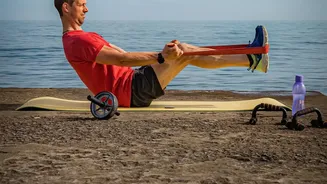
For a strong and healthy back, rows are non-negotiable. Using a resistance band makes this crucial pulling motion accessible anywhere. The seated band row is a powerhouse for building posture muscles, helping to counteract the slouching that comes from long hours spent at a desk or looking at a phone.
How to do it: Sit on the floor with your legs extended in front of you, knees slightly bent. Loop the resistance band around the soles of your feet and hold one end in each hand. Sit up tall with your back straight and your core engaged. Pull the handles of the band toward your waistline, squeezing your shoulder blades together as if you're trying to crack a nut between them. Your elbows should stay close to your body. Pause for a moment before slowly extending your arms back to the starting position.
Muscles worked: This exercise primarily strengthens the muscles of the upper and mid-back, including the latissimus dorsi, rhomboids, and trapezius. It also works your biceps and rear deltoids.
3. The Battle Rope Wave
If you want to combine strength, power, and cardiovascular conditioning into one explosive movement, look no further than the battle rope. The alternating wave is a fundamental move that torches calories and builds functional strength that translates to everyday activities. It's a low-impact, high-intensity exercise that engages your entire body.
How to do it: Anchor the middle of a battle rope around a sturdy pole or weight. Stand facing the anchor with your feet about shoulder-width apart in a slight squat or athletic stance. Grab one end of the rope in each hand with an overhand grip. From here, begin raising and lowering each arm in an alternating, rapid fashion to create a wave-like motion down the length of the rope. Keep your core tight and try to maintain the waves for a set time, like 30 seconds.
Muscles worked: While it may look like just an arm workout, battle ropes provide a full-body challenge. They hammer your arms, shoulders, back, and core, while your legs and glutes work hard to stabilize your body.
4. The Band Pull-Apart
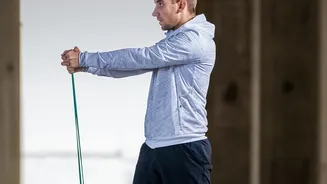
This simple-looking exercise is one of the most effective for shoulder health and improving posture. The band pull-apart strengthens the often-neglected muscles of the upper back and rear shoulders. Performing this move regularly can help stabilize your shoulder blades, improve your posture, and reduce the risk of shoulder injuries.
How to do it: Stand with your feet shoulder-width apart, holding a light-to-medium resistance band with both hands. Your grip should be about shoulder-width apart with your palms facing down. Raise your arms straight out in front of you at shoulder height. Keeping your arms straight, pull the band apart by squeezing your shoulder blades together. Imagine you are trying to stretch the band across your chest. Hold for a second at the point of maximum tension before slowly returning to the starting position with control.
Muscles worked: This move directly targets the rhomboids, rear deltoids, and the rotator cuff muscles, all of which are crucial for shoulder stability and good posture.
5. The Plank with Shoulder Taps
The plank is a gold-standard core exercise, but adding shoulder taps introduces a new challenge: anti-rotation. By lifting one hand off the floor, you force your core muscles to work overtime to keep your hips and shoulders from rotating. It’s a dynamic movement that builds exceptional stability through the core and shoulders.
How to do it: Start in a high plank (push-up) position, with your hands directly under your shoulders and your feet slightly wider than hip-width apart for a more stable base. Keeping your body in a straight line and your hips as still as possible, lift your right hand and tap your left shoulder. Place your right hand back on the floor and repeat on the other side, tapping your right shoulder with your left hand. The key is to minimize any rocking or swaying of your hips.
Muscles worked: This is a full-body exercise. It primarily strengthens the deep core muscles (transverse abdominis and obliques) but also engages the glutes, shoulders, chest, and triceps.