


An Illusion of Perspective
When we look up at the night sky, we are seeing a flattened, two-dimensional view of a three-dimensional universe. We have no natural sense of depth perception over such immense distances. This means two stars or galaxies that appear side-by-side could
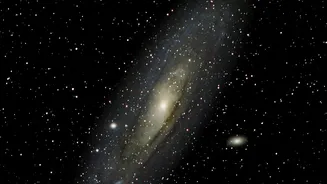
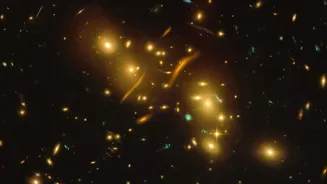
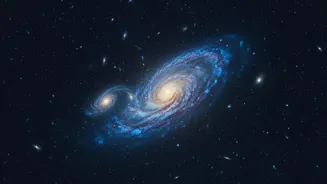
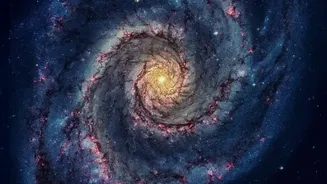
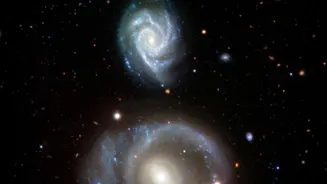
be cosmic neighbors, or they could be separated by millions of light-years, merely aligned along our line of sight from Earth. Astronomers call this a 'projection effect' or a 'chance alignment'. A recent image highlighting several galactic pairings serves as a perfect case study, demonstrating that what appears to be a close encounter might be nothing more than a trick of perspective. Distinguishing between a true interacting pair and a visual coincidence is a fundamental challenge for astronomers.
A Tale of Three Pairs
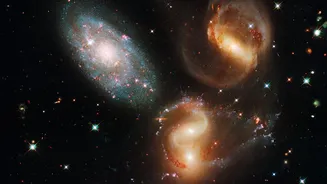
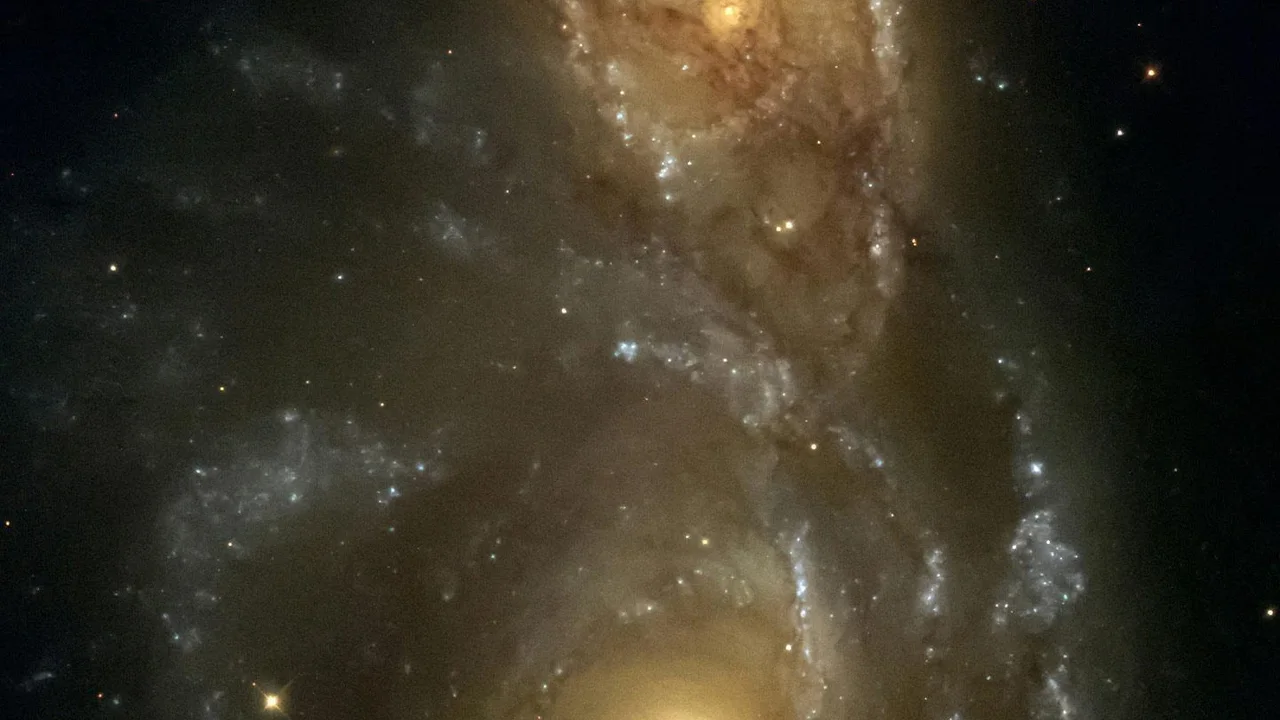
The image in question, highlighted as NASA's Astronomy Picture of the Day for August 10, 2026, features three sets of galaxies within the Centaurus Galaxy Cluster. Each pair tells a different story. The top pair includes a polar ring galaxy, NGC 4650A, whose unique structure is likely the result of a past collision, but it is not currently interacting with its apparent neighbor. The middle two galaxies seem close enough to be gravitationally linked, but astronomers have determined their relative speeds make a current interaction unlikely. It is only the bottom two, NGC 4622A and NGC 4622B, that are genuinely caught in a gravitational dance, actively merging into what will eventually become a single, larger galaxy over the next billion years or so.
How Astronomers Tell the Difference
So, if we can't trust our eyes, how do scientists determine if galaxies are true companions or just distant strangers? The primary tool is measuring their redshift. As the universe expands, light from distant objects gets stretched, shifting its color towards the red end of the spectrum. By measuring the redshift of each galaxy, astronomers can calculate its distance from Earth. If two adjacent galaxies have nearly identical redshifts, it confirms they are at the same distance and are therefore true neighbors, potentially interacting. Other visual clues can also point to a real merger, such as distorted shapes, long streams of stars and gas called tidal tails, or a bridge of material connecting the two galaxies—all signs of a powerful gravitational tug-of-war.
Why These Observations Matter
Studying both true and apparent galaxy pairs is crucial for understanding the universe. Actual mergers, like the one happening with the bottom pair, are a primary way that large galaxies, including our own Milky Way, have grown and evolved over cosmic time. These collisions trigger frenzies of new star formation as vast clouds of gas and dust are compressed. Even the optical illusions are useful. For example, when one galaxy is perfectly aligned in front of another, as in the famous case of NGC 3314, the background galaxy acts like a backlight. This allows astronomers to see the dark dust lanes of the foreground galaxy in silhouette, helping them map its structure in a way that would otherwise be impossible. These chance alignments can reveal details about galactic composition and the invisible matter that shapes them.